

The queue is full. Agents are taking payment calls, copying card details into one screen, documenting the conversation in another, and hoping nothing gets missed between the disclosure, the authorization, and the receipt. In healthcare, ARM, insurance, and utilities, that setup doesn't just slow collections. It creates audit gaps, raises PCI exposure, and keeps skilled staff tied up in work a system should handle.
That problem gets worse when communication and payment live in separate systems. A customer agrees to pay on a live call, then gets transferred to a disconnected workflow. An agent sends a text, but the payment link doesn't write back cleanly to the account record. A supervisor reviews a complaint and finds half the interaction history in one system and the transaction record somewhere else.
Organizations that treat communication and payments as separate functions are leaving cash on the table and inviting compliance failures.
Automating payment processing works when it's built into the contact center workflow itself. That means voice, SMS, chat, portal, agent desktop, audit trail, and payment rails all move together. In regulated environments, that isn't a nice-to-have. It's how teams reduce handling time, protect cardholder data, and maintain control over every payment conversation.
At 4:45 p.m., a patient calls to make a payment before the office closes. The agent verifies identity, explains the balance, reads the required disclosures, opens a separate payment screen, and starts keying in card data while documenting the call in the account system. One hold, one mistyped field, or one missing note turns a simple payment into rework, delay, and audit exposure.
That is the actual cost of manual payment processing inside a live contact center. The transaction itself may take a few minutes. The surrounding work: authentication, disclosures, data entry, exception handling, documentation, and reconciliation, consumes far more time than leaders usually account for.
The failure point is workflow fragmentation.
In healthcare and ARM environments, voice, SMS, payment acceptance, and account documentation often sit in separate systems. Agents compensate by copying account numbers, pasting balances, typing payment promises into notes, and trying to keep the conversation compliant while they switch screens. Those workarounds create a process that depends on individual discipline instead of system control.
A significant gap exists between payment automation and compliance-specific communication workflows. Many organizations can automate payment posting or offer a basic online payment page. Fewer can capture a payment securely during a live call, send a compliant text payment option, write the outcome back to the account, and preserve a clean audit trail across the full interaction. That gap matters more as payment systems become more machine-driven, which is part of the direction outlined in the Machine Payments Protocol.
The operational drag is easy to miss because it is spread across hundreds or thousands of interactions. One extra minute to re-enter data. Another to correct a failed authorization. Another to reconcile a processor record that never made it back to the patient account or collection system.
A retail merchant can tolerate some disconnect between communication and payment. A hospital business office or collection agency has less room for error because every payment conversation carries documentation and compliance requirements.
I have seen this pattern in both patient billing and collections operations. The first sign is rarely a security incident. It is rising handle time, inconsistent notes, more payment exceptions, and supervisors spending too much time validating basic transactions after the fact.
Practical rule: If an agent has to manually re-enter payment information after the customer agrees to pay, the process is already difficult to control.
The hidden cost is not just labor. It is loss of control over the payment conversation itself. Teams lose confidence that the right disclosures were delivered, the payment was taken through an approved path, the account record reflects what occurred, and the organization can prove all of it later.
Automating payment processing isn't one feature. It's a set of connected workflows that remove manual payment handling from the middle of customer interactions while still preserving control, documentation, and compliance.
That usually includes self-service IVR, secure web payment portals, scheduled and recurring payment plans, and automated digital outreach that routes the customer to the right payment path. In more advanced environments, it also includes AI agents that can handle account interactions and guide payment resolution without forcing every transaction through a live representative.
A manual collections call usually looks like this:
That process is slow, repetitive, and hard to govern at scale.
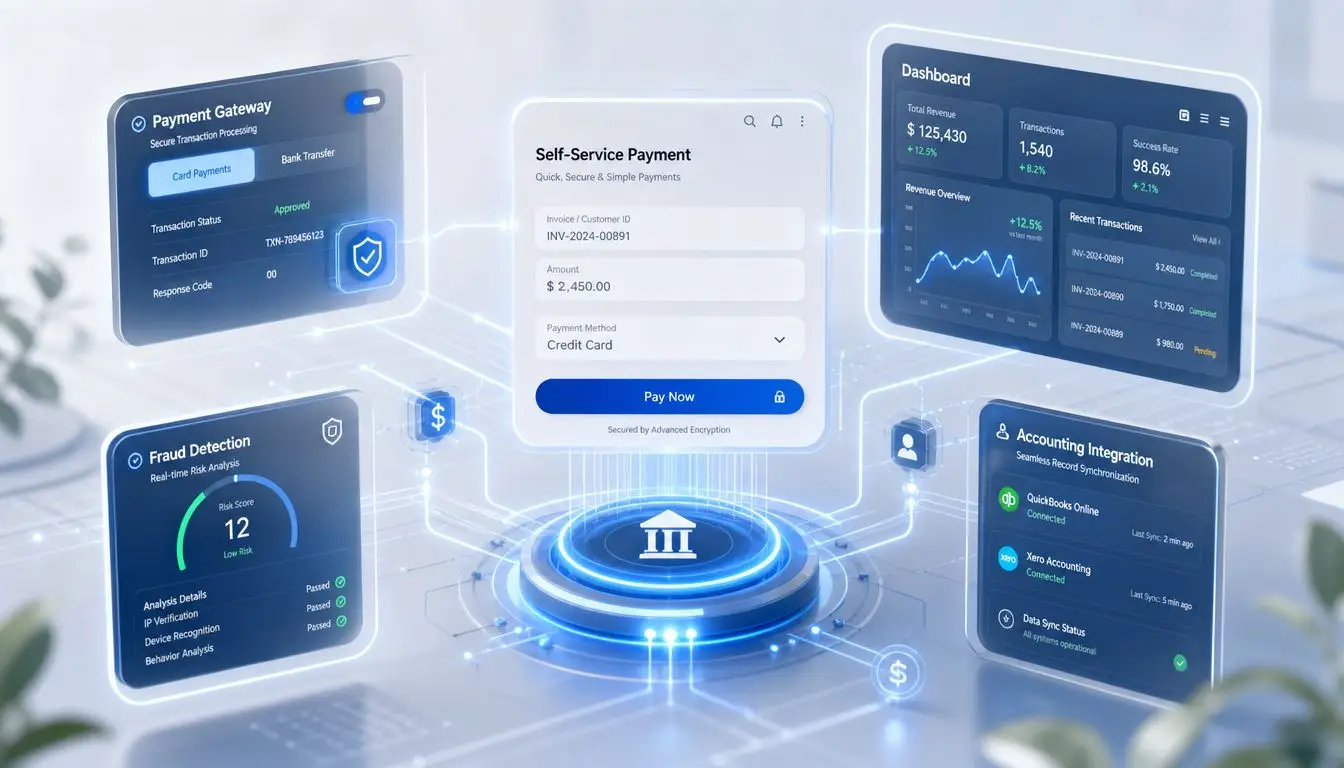
An automated workflow looks different. The agent or system verifies the account, presents payment options, then routes the customer to a secure path without exposing card data to the representative. The customer can complete the payment by secure IVR, by a compliant payment link sent through SMS or email, or through a self-service portal tied directly to the account record.
The strongest setups include a few core pieces:
For teams evaluating where payments are heading beyond person-to-person workflows, Zinc's explanation of the Machine Payments Protocol is a useful read because it frames payment automation as an orchestration layer, not just a checkout event.
A unified approach is what changes the operating model. Intelligent Contacts, for example, combines contact center communication and payment handling in one workflow so teams don't have to bolt a payment process onto a separate engagement stack. That matters because the biggest gains don't come from adding a payment form. They come from removing the swivel-chair work between conversation, authorization, and account update.
A good automation design doesn't ask agents to work faster. It removes steps agents shouldn't be doing in the first place.
At 4:45 p.m., the agent queue is full, payment promises are due that day, and a patient or debtor is ready to pay now. In a manual process, that payment waits for an available agent, gets rekeyed into another system, and creates one more opportunity for an error or a PCI problem. In an automated contact center workflow, the conversation stays on track while the payment moves through a secure path tied to the account record.
That difference shows up in both revenue cycle performance and compliance exposure.
The market has shifted toward electronic payments, and contact centers in healthcare and ARM feel that shift directly. Customers expect to resolve balances on their schedule, whether that happens during a call, after hours from a texted link, or through a portal after reviewing account details. Analysts tracking payment adoption and teams developing payment processing systems both point to the same reality. Payment processing now has to support speed, channel flexibility, and reliable system-to-system handoff.
Inside a live contact center, the return is not just faster transactions. It is better use of labor.
I have seen the biggest gains come from removing friction at the exact point where a customer is ready to act. If an agent has to pause, authenticate in a second system, collect card data manually, and then document the result after the call, the organization pays for that delay several times. It pays in handle time, in staffing pressure, and in missed payments from people who intended to resolve the balance but did not finish.
In regulated environments, automation earns its keep by reducing process variation.
A controlled payment workflow limits who can access sensitive payment data and how they access it. It standardizes disclosures, time stamps each step, records authorization events consistently, and keeps the payment activity attached to the communication history. That matters during audits, complaint reviews, and internal investigations, because staff can verify what happened without piecing together records from separate systems.
For ARM and healthcare teams, that control has to exist inside the customer interaction, not beside it. A portal or IVR that sits outside the collection workflow may still accept payments, but it often leaves gaps around disclosures, account context, and documentation. The built-in compliance features for ARM payment portals show what a tighter model looks like when the payment path, account rules, and audit trail are designed together.
The business case and the compliance case are the same decision. A payment process that reduces agent effort but creates audit gaps is expensive in a different way. A payment process that satisfies policy but slows down customers and staff will hold back collections and patient payments. Good automation fixes both.
Most payment automation failures start with architecture, not intent. Teams buy separate communication, payment, and messaging components, then try to stitch them together after the fact. On paper, that looks flexible. In practice, it usually creates blind spots.
A fragmented stack is the common model. One system handles calls. Another sends texts. A separate gateway processes payments. The account system stores balances. Reporting sits somewhere else.
That architecture creates three operational problems:

A useful way to think about it is this. A fragmented stack is like building an engine from parts designed for different machines. The parts may connect. That doesn't mean the system will run cleanly under load.
For teams that want a technical grounding in the tradeoffs behind developing payment processing systems, that resource gives helpful context on what has to be coordinated below the surface.
A unified architecture keeps communication and payment in the same operating environment. Voice, SMS, chat, secure links, transaction events, and account records follow one workflow instead of being passed across multiple tools.
That model creates tighter control because it centralizes the event chain. A customer receives a message, opens a secure payment path, completes the transaction, and triggers account updates without requiring staff to broker each step manually.
A secure architecture should also include payment data protection from the start. That's where point-to-point encryption within the payment flow becomes operationally important, not just technically desirable. If payment capture is protected at the point of entry, the contact center reduces unnecessary exposure across the rest of the environment.
The architecture decision isn't about convenience. It's about whether the organization can prove what happened from first outreach to final payment.
In regulated contact centers, that proof matters every day. Not just during an audit.
At 2 p.m., the phones are full, agents are taking payments, supervisors are watching hold times climb, and a single failed handoff between the billing system and the payment flow creates rework for three teams. That is the actual implementation environment in healthcare and ARM. Payment automation has to work inside live conversations, under compliance rules, with no room for confusion on the agent desktop.
A rollout succeeds when leadership treats it as an operating change with system consequences. The order matters. The workflow design matters. The platform choice determines how much manual handling stays in place after go-live.

Map the payment process as it runs during calls, texts, callbacks, and payment-plan discussions. Policy diagrams are not enough. Teams need to see where agents speak card data into the process, where customers drop out of self-service, where accounts wait for supervisor review, and where payment status fails to return to the system of record.
That review should cover inbound payments, outbound collections, promise-to-pay workflows, retries, disputes, exceptions, and post-payment documentation. In a live contact center, each of those steps affects staffing, QA review, and customer experience.
A useful assessment answers four questions:
That baseline usually surfaces the true cost drivers. They are often not processor fees. They are agent minutes, duplicate work, abandoned payment attempts, and weak audit history.
A regulated organization does not need more disconnected features. It needs a platform that fits the way agents, supervisors, billing teams, and compliance staff already work.
Look for a single healthcare-ready platform with built-in HIPAA and PCI controls, clear audit history, and payment capture methods that reduce agent exposure to sensitive data. The goal is not to bolt payment tools onto the side of the contact center. The goal is to let a payment move from conversation to authorization to account update in one controlled workflow. That is the standard for secure payment processing for contact centers.
Selection criteria should stay tied to day-to-day operations:
Start with one use case that removes friction quickly and carries manageable risk. In many organizations, that means inbound self-service payments, agent-initiated secure payment links, or digital payment options tied to existing account outreach.
Then expand carefully. Add payment plans. Add reminders. Add agent-assist tools for customers who begin in self-service but need help finishing. Each phase should reduce live-agent handling without breaking the customer conversation.
Training has to be specific. Agents need scripts for introducing secure payment options, rules for when to stay on the line, and clear guidance on when an account must stay with a representative. Supervisors need to review exception patterns, not just transaction totals.
Go-live is the start of process tuning. The teams that get the best results keep adjusting the points where customers hesitate, abandon the payment path, or call back because the account was not updated correctly.
A patient calls to pay a balance after discussing a procedure. A collections consumer agrees to settle, but only if the agent can text a secure link while staying on the line. In both cases, compliance risk sits inside the live interaction. If the workflow exposes card data, stores the wrong account notes, or sends follow-up messages without the right controls, the problem starts before the payment even posts.

In healthcare and ARM environments, payment controls cannot sit outside the contact center stack. Agents, IVR, SMS, portals, call recordings, QA tools, and account systems all touch the same interaction. If cardholder data enters the wrong part of that chain, scope expands fast and audit exposure grows with it.
PCI DSS 4.0.1 requires disciplined separation of cardholder data from other sensitive records. In healthcare, that matters because payment data and PHI may be discussed in the same conversation but should not be stored, displayed, or transmitted through the same workflow components.
That affects design choices immediately. The payment path should isolate card capture from the agent desktop as early as possible. Recording controls should pause or suppress sensitive payment moments. Audit trails should log each payment event at the system level, including who initiated it, what channel was used, and whether the transaction completed or failed.
A practical control set includes:
For teams designing these workflows inside active service and collections operations, secure payment processing for contact center environments shows how those controls fit into agent-assisted and self-service interactions.
Patient financial conversations often include diagnosis context, treatment dates, insurance details, or other PHI. That means the payment interaction has to be secure beyond the transaction itself. The surrounding conversation, account notes, screen views, and downstream records all matter.
The operational mistake I see often is narrow scoping. Teams secure the card entry point but leave PHI exposed in recordings, disposition notes, or broad desktop permissions. Many implementations fail at this point.
A healthcare payment workflow needs role-based access, encryption, clear retention rules, and vendor agreements where PHI is involved. It also needs tighter process discipline. Billing staff may need enough context to explain a balance or payment plan, but they should not automatically get access to the full clinical record, and the payment system should not become a secondary repository for patient information.
Collections teams have a different compliance burden because payment automation often starts before the customer reaches an agent. Reminder calls, SMS payment links, voicemail drops, and follow-up notices all need rules that the system enforces consistently.
The control points are practical, not theoretical:
| Control area | Why it matters in payment automation |
|---|---|
| Consent handling | Payment reminders and digital outreach must follow the customer's documented permissions and channel preferences. |
| Timing rules | Outbound communications need to stay within legal and policy limits for contact windows and frequency. |
| Message history | Teams need a defensible record of what was sent, when it was sent, and what payment or dispute activity followed. |
In live collections work, compliance and conversion are tied together. Agents need approved ways to send links, pause outreach, document disputes, and hand customers from a conversation into a secure payment path without creating new exposure. Controls built into the workflow reduce both regulatory risk and rework. Controls added after go-live usually leave gaps that supervisors end up managing by hand.
A payment workflow is not successful because it launched on time. It is successful when a caller can move from a live conversation to a completed payment, a documented arrangement, or a secure self-service path without adding follow-up work for agents, supervisors, or compliance staff.
In healthcare and ARM contact centers, that means measuring more than collections dollars. Teams need to know whether automation reduced handle time, cut repeat calls, improved payment completion, and produced records that stand up in an audit or complaint review.
Start with the operating metrics that show whether the workflow is taking pressure off the floor. Payment completion rate, self-service adoption, agent-assisted payment volume, exception volume, and cost per successful payment are the core numbers. In a live contact center, I would also track call containment after a payment link is sent, repeat contacts within seven days, and the share of payments that require back-office correction.
Failed payments deserve their own review. Some failures come from expired cards or insufficient funds. Others come from process design. Wrong balance data, confusing payment screens, broken handoffs from agent to IVR or SMS, and delayed posting all create avoidable fallout. If teams treat those failures as normal background noise, they miss the fixes that improve both cash flow and customer experience.
One metric often gets ignored. Measure how long it takes to reconcile a payment inquiry. If a patient or debtor says, "I paid already," supervisors should be able to verify the transaction, the channel used, the timestamp, and any agent involvement quickly. If that answer still takes ten minutes and three systems, the automation layer did not solve the core operating problem.
The failures I see are usually workflow failures dressed up as technology issues.
The common thread is simple. Contact centers do not get value from payment automation by adding a payment page. They get value by connecting outreach, agent guidance, payment capture, posting, and documentation in one controlled process.
The business case should be tied to work removed from the operation. Count fewer agent minutes spent taking payments, fewer inbound calls about receipts or failed attempts, less rework in posting and reconciliation, and fewer compliance escalations caused by missing records.
Then look at recovery quality. If automation increases payment volume but also increases disputes, failed attempts, or complaint handling time, the gains are overstated. Good reporting keeps revenue metrics and control metrics side by side so leaders can see whether performance improved cleanly or just shifted work to another team.
Strong payment automation lowers operating cost and improves proof at the same time. If one side is missing, the design needs work.
Automating payment processing works best when communication and payment happen in one controlled workflow. For organizations in healthcare, ARM, financial services, insurance, government, and utilities, that approach reduces manual handling, improves auditability, and makes secure self-service practical at scale. Schedule a Demo to see how Intelligent Contacts brings voice, SMS, chat, and payments together in one system, or See Your ROI to build a business case around your current payment volume and workflow. For direct questions, contact Intelligent Contacts through the team.