
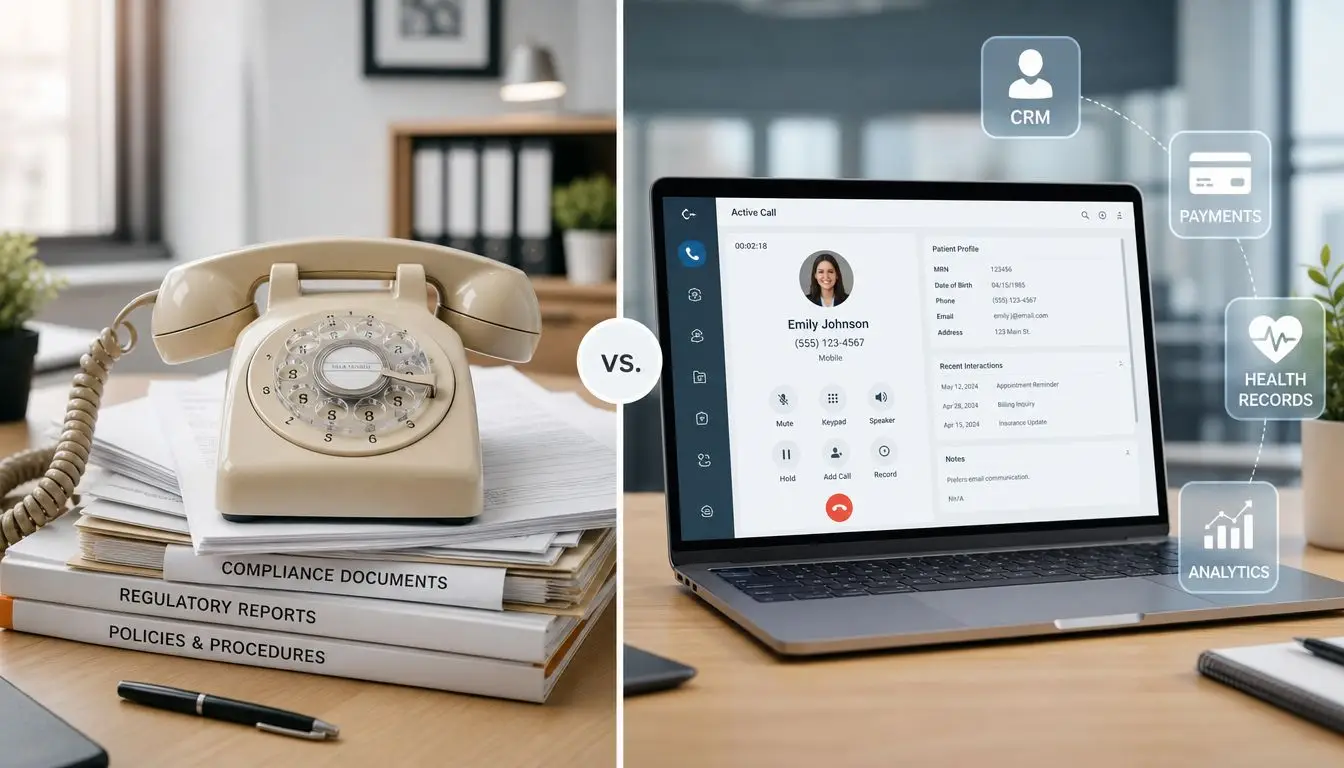
A lot of operations directors are sitting in the same uncomfortable spot. The contact center is expected to prove TCPA controls, protect PHI under HIPAA, take payments under PCI-DSS, document disputes, route calls intelligently, and feed clean data into the CRM or EHR. But the phone layer still behaves like a disconnected utility instead of part of the operating model.
That gap creates friction everywhere. Supervisors can't see enough detail. Compliance teams rely on manual workarounds. IT keeps a legacy voice environment alive while the rest of the business has moved to software-defined systems. In regulated environments, the VoIP vs Landline decision isn't really about whether a dial tone exists. It's about whether the communication channel supports auditable, secure, integrated work.
| Category | VoIP | Landline |
|---|---|---|
| Core architecture | Internet-based, software-defined calling | PSTN-based, fixed physical line |
| Scalability | Add users and routing logic through software | Add lines through carrier and physical infrastructure |
| Workflow integration | Connects with CRM, EHR, payment, and reporting workflows | Limited without extra hardware and separate systems |
| Compliance support | Can support encryption, access controls, audit trails, and policy-based workflows | Relies heavily on manual process controls |
| Emergency calling | Flexible, but location accuracy must be managed carefully | Fixed physical location is a built-in advantage |
| Power outage behavior | Needs power and network redundancy planning | Maintains service through PSTN power delivery |
| Best fit | High-volume, data-driven, regulated operations | Backup lines, fixed-location emergency use cases, limited environments |
A healthcare billing team with legacy desk phones usually looks stable from the outside. Calls still come in. Agents still dial out. Managers still get end-of-day reports from three different systems stitched together in a spreadsheet.
Underneath that surface, the process is brittle. An address change has to be updated in one system, but not the phone system. A payment promise gets recorded in the account notes, but the call metadata doesn't follow the account cleanly. When compliance asks for a defensible trail around outreach activity, staff have to reconstruct it manually.
That's why the old VoIP vs Landline debate no longer starts with call quality or familiarity. It starts with operational fit.
Between 2008 and 2017, business reliance on Plain Old Telephone Service fell by 49% in the United States, while business VoIP adoption grew by 1,062%, according to Circle's summary of FCC-documented market shifts. That wasn't a cosmetic market trend. It marked the point where business communications moved from fixed copper infrastructure to internet-based systems built for scale, flexibility, and software integration.
In collections, healthcare revenue cycle, financial services, insurance, government, and utilities, voice isn't a stand-alone channel. It's tied to consent management, identity verification, payment handling, dispute tracking, and escalation workflows.
A landline can still place and receive calls. That isn't the issue.
The issue is that a fixed analog system doesn't naturally support the operating discipline these teams need. It doesn't natively create a rich audit trail. It doesn't fit cleanly into omnichannel communication. It doesn't help a supervisor answer basic questions fast, such as which queues are backing up, which call outcomes are increasing, or whether a callback process is being followed consistently.
Operational reality: A regulated contact center rarely fails because people can't make calls. It fails because the call process can't be documented, controlled, and connected to the rest of the workflow.
For some organizations, keeping a small number of landlines still makes sense. Fixed-location emergency coverage and last-resort redundancy are legitimate reasons.
But as a primary operating model, landlines usually create more manual work than they remove. In modern contact centers, the comparison is simple:
That's the lens that matters. Everything else follows from it.
The infrastructure difference explains almost every trade-off in VoIP vs Landline. One runs on a dedicated telephone network. The other runs as software over data networks.
A landline uses the Public Switched Telephone Network, which ties service to physical wiring and a fixed endpoint. That model is stable, but it's also rigid. Every move, add, routing change, or feature expansion tends to involve hardware, carrier coordination, or both.
VoIP works differently. Voice is converted into digital packets and carried over the same kind of network environment the business already uses for applications, reporting, and integrations. That's why VoIP behaves less like a utility line and more like an operating layer.
A static system tends to create static processes. If a queue needs to be restructured, if an after-hours workflow changes, or if agents need to work from another site, a landline environment usually resists that change.
A software-based environment handles those changes better because configuration happens in software, not through physical rewiring. That difference affects more than convenience. It affects speed of execution when a compliance policy changes or a department has to absorb new volume.
For teams evaluating adjacent connectivity options, SwiftNet explores Starlink phone service in a way that's useful for understanding how modern business telephony increasingly depends on network design rather than fixed copper assumptions.
The phone system rarely stays in its lane. Once the business needs call recording, queue logic, branch routing, reporting, or system integration, the underlying architecture starts to matter.
A PSTN-based model tends to separate voice from the rest of the stack. A VoIP model lets voice coexist with other digital services on the network. That creates a very different management experience.
The difference becomes clearer when looking at how multi-line phone systems for small business have evolved from fixed line management to software-controlled communications.
A landline is hardware-defined. VoIP is software-defined. Once that clicks, the rest of the comparison stops feeling abstract.
Landlines still offer one thing software flexibility can't replicate on its own. Their physical tie to a location creates predictability. In some emergency-sensitive workflows, that matters.
But fixed-location certainty comes at a cost. It limits mobility, slows changes, and keeps voice isolated from the systems that regulated contact centers rely on every day. For operations leaders, that's usually the point where the infrastructure conversation becomes a workflow conversation.
A modern contact center lives or dies on what happens during the call, after the call, and around the call. In regulated environments, the phone system has to support routing policy, agent workflow, audit needs, and recordkeeping without forcing staff to patch those pieces together by hand.

That is the real capability gap.
VoIP fits modern contact center work because it sits inside the software environment the operation already depends on. It can route calls based on business rules, connect activity to customer or patient records, support call recording policies, and give supervisors usable reporting without relying on separate hardware layers. A traditional landline setup can still carry a call, but once a team needs queue logic, searchable recordings, screen pops, or policy-based workflows, the work usually shifts to external systems, on-site PBX equipment, or manual processes.
For an ARM agency, a patient billing group, or a financial services contact center, those differences affect daily output and compliance exposure.
| Capability | VoIP | Landline |
|---|---|---|
| Intelligent routing | Strong fit for skills-based, time-based, and queue-based routing | Limited without separate hardware and added complexity |
| IVR handling | Supports layered menus, self-service flows, and directed routing | Basic functionality unless expanded through external systems |
| Reporting | Real-time and historical reporting are natural fits | Usually fragmented or dependent on separate tools |
| Recording and review | Easier to structure for QA, audit, and coaching workflows | Often requires add-ons and disconnected storage |
| CRM and EHR alignment | Stronger fit for screen pops, disposition data, and activity linking | Limited native compatibility |
| Agent mobility | Supports remote and distributed staff through software endpoints | Tied to physical desks and local wiring |
In high-volume environments, call handling rules cannot live in a supervisor's head. They need to live in the system.
Outbound teams need dialing controls, callback management, agent state management, and account-level workflow support. Inbound teams need IVR paths that reflect real business logic, not a generic phone tree. A healthcare billing operation may need one path for payment calls, another for disputes, and another for insurance follow-up. A financial services team may need calls segmented by servicing group, language, and call reason before the agent even picks up.
That changes agent performance. It also changes risk.
Supervisors need more than call recordings and carrier records. They need queue visibility, transfer patterns, disposition trends, adherence data, and review workflows that stand up during internal audits or dispute investigations. VoIP platforms usually handle those requirements as part of the operating model. Landline environments often treat them as separate projects.
Practical takeaway: If the phone system cannot connect routing, reporting, and call records to the rest of the workflow, agents spend time compensating for the system. In regulated contact centers, that usually means slower handling, weaker documentation, and more room for error.
Landlines still fit low-volume settings with fixed desks, limited call flows, and minimal reporting needs.
The problem shows up when the operation needs policy-driven handling. Calls may need to route by account type, business hours, licensing rules, language preference, or exception status. Recordings may need to be retained, reviewed, and retrieved in a structured way. Agents may need account context on screen while speaking with a consumer or patient. Managers may need continuity when weather, office closures, or staffing changes disrupt a physical site.
A landline setup can support pieces of that. It usually does not support all of it efficiently.
In practice, that is why regulated organizations move away from viewing VoIP as a phone replacement. They use it as an operating layer for the contact center, one that supports compliance controls, workflow integration, and supervisory oversight in the same environment.
A regulated contact center rarely gets into trouble because the monthly dial tone cost was too high. Trouble starts when an audit team needs a recording, a supervisor needs to change routing by policy, or a site disruption forces agents to work elsewhere and the phone environment cannot adapt without extra labor, extra vendors, or delay.

That is why line rates are only one line item. Total cost of ownership includes the hardware you maintain, the staff time required to support changes, the extra systems needed for recording and reporting, the cost of downtime planning, and the operational drag created when voice sits outside the rest of the workflow.
Landline environments often look inexpensive because many costs are hidden in separate budgets. Telecom pays for circuits. IT pays for old hardware support. Operations absorbs the time spent on workarounds. Compliance absorbs the pain when records are hard to retrieve.
The usual cost centers are predictable:
Those expenses matter. The bigger issue is labor.
If supervisors have to pull call records from one place, recordings from another, and customer context from a third system, every investigation takes longer. In a regulated operation, that delay has a real cost.
VoIP usually shifts spending away from fixed infrastructure and toward an operating expense that is easier to forecast. That matters to finance, but it matters just as much to operations. Policy changes, schedule changes, and staffing changes can often be handled in software instead of through field work.
The savings case is strongest when the phone system is part of the operating model, not a stand-alone utility. If agents can work from approved devices, if routing rules can change without replacing hardware, and if call data feeds the systems managers already use, the organization cuts waste that never appears on a carrier invoice.
A sound VoIP budget should still include the pieces buyers often skip during procurement. Redundant connectivity is critical for internet reliability. Emergency response configuration also carries implementation and governance work, especially for multi-site and hybrid teams using E911 support for VoIP environments.
I usually recommend evaluating TCO with four practical questions instead of one price comparison.
What does the current environment cost to keep running?
Include carrier service, hardware support, administration time, and the internal effort required to handle routine changes.
What does a policy or workflow change cost?
In regulated contact centers, call flows change. New lines of business launch. Teams split by license, geography, language, or escalation type. The system should support that without a large services bill.
What does evidence retrieval cost during an audit or dispute?
If recordings, timestamps, call notes, and routing history are difficult to find, the business is paying in legal exposure, QA hours, and management time.
What does the system prevent the operation from doing well?
If agents cannot work efficiently across locations, if supervisors cannot see what is happening in real time, or if the phone layer cannot connect to the rest of the workflow, those limits become an ongoing operating cost.
The lowest quoted option often becomes the most expensive one to run. For regulated organizations, the TCO question is not whether VoIP or landline has the cheaper monthly bill. It is which model gives the business tighter cost control, cleaner compliance support, and fewer manual workarounds over time.
At 8:15 on a Monday, reliability stops being a technical debate. A storm hits one office, commercial power drops, a local circuit starts flapping, and the contact center still has to answer patients, policyholders, or borrowers on time. That is the standard that matters in regulated operations.
The old VoIP versus landline argument puts too much weight on the wrong question. The key issue is whether the calling environment can stay available, preserve call quality, and keep staff working through a local failure without creating compliance gaps or manual workarounds.
Landlines still have one clear operational advantage. A traditional copper line can keep working during a power outage because the line itself carries power from the public switched network. That matters for fixed locations with emergency-sensitive use cases.
VoIP reliability depends on design quality instead of copper-line power. If the network is stable, traffic is prioritized correctly, and failover paths are in place, voice quality is usually consistent and clear. If the business runs voice over an unstable connection with no backup internet, no battery support, and no alternate device path, the weakness shows up fast.
In live environments, poor voice quality usually traces back to congestion, jitter, packet loss, or misconfigured quality-of-service policies. Aging analog wiring can create its own problems, but modern call quality failures are often local network failures dressed up as a phone-system complaint.
I advise operations teams to test for three conditions. What happens during peak usage. What happens when the primary circuit degrades. What happens when agents need to shift from desk phones to laptops or mobile devices with little notice. Those tests reveal more than any sales demo.
For cloud voice, the practical question is simple. If one part of the environment fails, can calls keep flowing and can staff keep working?
That is why network redundancy is critical for internet reliability for contact centers that treat telephony as a front-line operating system rather than a utility.
A sound resilience plan usually includes:
One line staying alive is helpful. An operation staying functional is better.
I still see good reasons to retain limited landline capacity in clinics, security desks, branch lobbies, and other fixed locations where deterministic local dialing behavior matters more than routing flexibility. In those cases, a copper line can serve as a narrow-purpose safeguard.
But landline reliability has boundaries. It is tied to one location, one physical path, and a much narrower set of recovery options. If the building is inaccessible, if the staff is displaced, or if the line itself is damaged, that dependability does not extend very far.
For regulated contact centers, the stronger model is often a hybrid decision. Use VoIP as the primary platform because it supports continuity across locations, better queue control, and supervisor visibility. Keep selective fixed-line coverage where local emergency behavior or site-specific resilience justifies it.
A call reaches the right queue. The agent verifies the caller. Payment is taken. A recording is stored. Notes are pushed into the account record. In a regulated operation, compliance exposure lives inside that workflow, not just in the voice connection itself.

That is why the VoIP versus landline decision looks different in healthcare, financial services, utilities, government, and collections. The question is not whether the line sounds clear. The question is whether the system supports documented controls, restricted access, auditability, and secure handling across the full customer interaction.
VoIP has an advantage here because it can sit inside controlled digital workflows. Landlines usually sit beside them. That difference shows up quickly under HIPAA, PCI-DSS, TCPA, FDCPA, and FCRA requirements, where proof of process matters as much as the process itself.
A basic voice call does not stay basic for long in a healthcare environment. The moment a call touches recordings, voicemail, transcription, CRM notes, EHR-linked activity, or any stored digital interaction tied to a patient, the organization has to treat that data accordingly and control who can access it.
That shifts the buying criteria.
A traditional landline can still serve fixed functions in healthcare settings. But if supervisors need recording access, if billing teams need account context during the call, or if staff need traceable follow-up across locations, manual controls stop carrying the load. The business needs administrative controls and technical safeguards it can show during an audit or incident review.
A practical compliance review should ask:
I still hear landlines described as safer because they are not internet-native. That is too narrow for regulated operations.
The larger risk in a contact center is often inconsistent process control. Agents write notes in different places. Recordings are handled unevenly. Access decisions depend on habit instead of policy. Payment steps happen outside the monitored workflow. Logs are fragmented across systems. A plain voice path does not solve any of that.
In practice, analog simplicity often shifts more risk onto people and policy. That is a weak position for any team that expects audits, disputes, or formal complaints.
VoIP gives operations and compliance leaders more ways to build controls into daily work:
Teams reviewing these issues in detail should look at a contact center security framework that covers communications, storage, user access, and operational policy together.
In regulated environments, manual usually means harder to audit, harder to scale, and harder to defend.
VoIP's flexibility creates a significant emergency-calling challenge. Because the service does not have a fixed physical connection to one copper endpoint, location accuracy has to be managed through process, configuration, and user discipline.
That matters in clinics, branch offices, utility field support, public service desks, and any operation where an agent may need emergency escalation tied to a physical site. If users move between locations, work remotely, or sign in from softphones, emergency response details have to be kept current. Otherwise, the business can end up with a modern calling platform and a weak emergency response posture.
This does not make landlines the better primary platform for regulated contact centers. It means emergency design needs its own operating standard. Location management, user training, testing, and selective fixed-line coverage for high-risk locations should be decided upfront, not after rollout.
For regulated business operations, the safer long-term model is usually a governed VoIP environment, not because VoIP is automatically compliant, but because it can support the controls, visibility, and workflow discipline regulators and internal audit teams expect.
Landlines still belong in targeted roles. Security desks, clinical stations, lobbies, and site-specific emergency points are common examples. But for day-to-day regulated workflows, organizations usually need the security model and audit structure that digital systems can support more effectively than analog lines.
By the time a team reaches migration planning, the technical decision is usually already made. The harder question is whether the selected partner can support regulated operations without forcing the business back into a stitched-together stack.

A good vendor review should feel less like a feature demo and more like an operational risk assessment. If the provider can't answer direct questions about compliance, implementation, payments, and integration paths, the business will end up doing the hard work itself.
The cleanest migrations usually share the same traits.
First, the team decides which landline functions must remain for emergency or site-specific reasons. That prevents false all-or-nothing thinking.
Second, the organization maps the workflows, not just the phone numbers. Queue design, payment handling, after-hours paths, escalation logic, recording policy, and user roles should be defined before cutover.
Third, the business chooses a platform that can reduce system sprawl instead of recreating it in the cloud.
Selection rule: Don't replace a legacy phone line with a modern patchwork. Replace it with an operating system for compliant communication.
For organizations under compliance pressure, Intelligent Contacts fits the practical checklist better than most generic voice offerings. It is a unified contact center and payments platform, which matters because communication and payment handling often belong in the same controlled workflow.
Its technology is built in-house rather than assembled as a reseller stack. That gives regulated teams clearer accountability, cleaner integration paths, and less finger-pointing when operations need changes. Implementation happens in days, not weeks, and the platform supports the workflows these environments run, including voice, SMS, email, chat, secure payments, intelligent routing, analytics, and Grace, the AI collection agent.
For collections agencies, healthcare revenue cycle teams, financial services contact centers, insurers, government offices, and utilities, that combination matters. The goal isn't just to modernize telephony. The goal is to move from first contact to final payment inside one defensible workflow.
Intelligent Contacts helps regulated organizations replace disconnected voice systems with a unified contact center and payments platform built for TCPA, HIPAA, PCI-DSS, FDCPA, and FCRA-sensitive operations. Teams in collections, healthcare revenue cycle, financial services, insurance, government, and utilities use it to manage communication, routing, compliance controls, analytics, and secure payments in one environment. To evaluate fit, Schedule a Demo or See Your ROI. For direct inquiries, contact Intelligent Contacts through the team at Intelligent Contacts.