
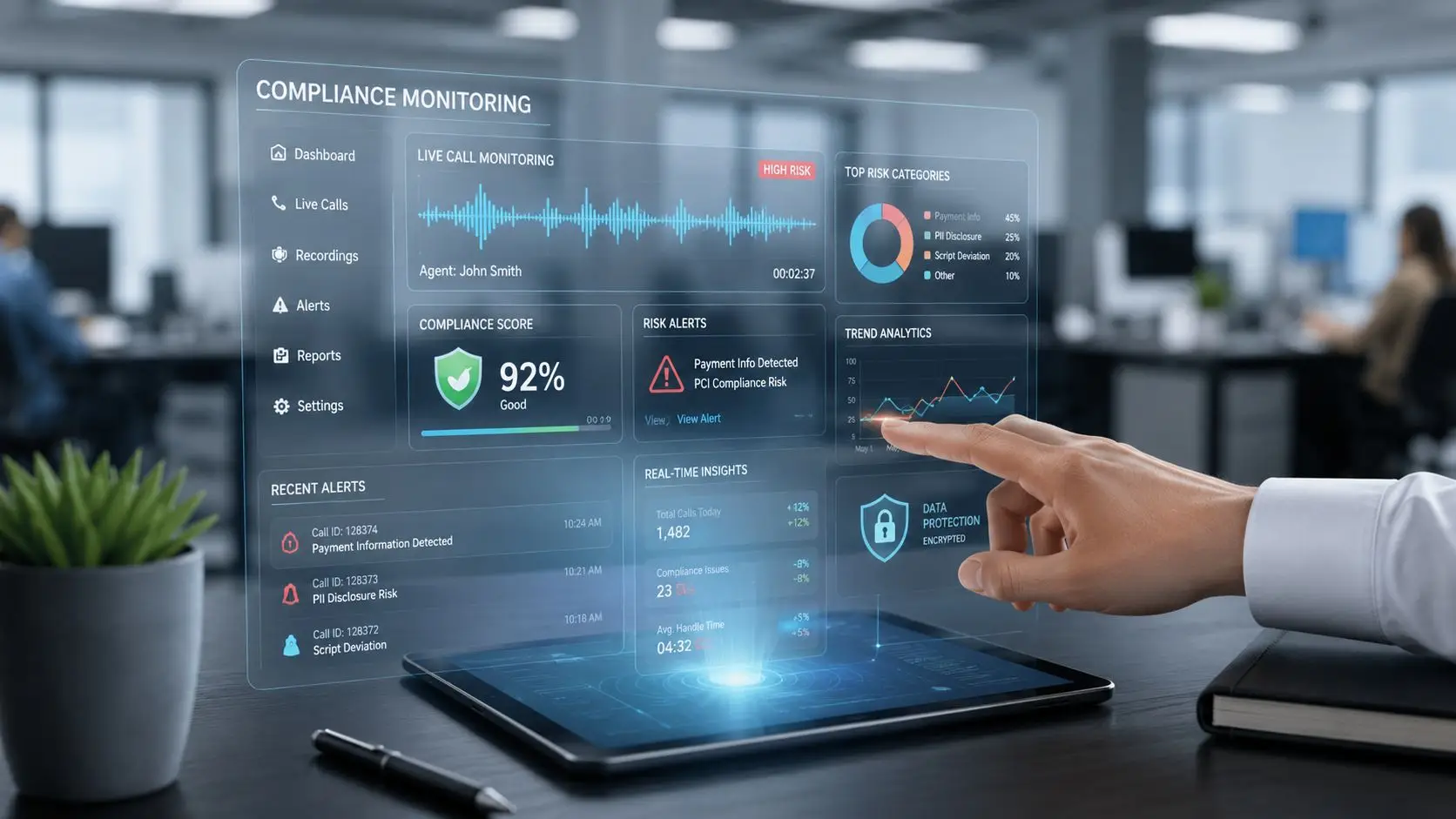
The warning sign usually isn't a regulator. It's an internal scramble.
A supervisor needs proof that a customer consented to outreach. Finance needs to confirm what happened during the payment step. Compliance needs the call, the screen activity, the payment record, and the disposition history lined up on one timeline. Instead, those records live in separate systems, owned by different teams, with different retention rules and different reporting logic.
That setup survives until something small goes wrong. Then it turns into a fire drill.
Most regulated contact centers believe they have coverage because they've bought software for recording, software for payments, and software for policy management. That sounds responsible. In practice, it often creates the exact gap regulators and auditors notice first.

The common failure point is dual-tool fragmentation. One system handles internal controls and audit prep. Another watches external regulatory changes or supports adjacent workflows like payments and communication review. The result isn't redundancy. It's delay, mismatch, and blind spots.
Data shows that 80% of organizations use at least two distinct compliance tools, creating data silos that delay response times by days during fast-moving regulatory shifts. For collections, healthcare revenue cycle, financial services contact centers, insurance, government, and utilities, “days” is a dangerous amount of time.
A payment workflow can drift out of alignment with call handling rules. A texting campaign can continue after a consent status changes. A customer dispute can require records from multiple systems that weren't designed to tell one story.
Operational reality: The moment a team has to prove one compliant customer journey by stitching together communication logs, payment records, and policy evidence from separate systems, the software stack is already working against them.
This isn't a niche software category anymore. Mordor Intelligence estimates the compliance software market will grow from USD 35.37 billion in 2025 to USD 74.12 billion by 2031 at a CAGR of 12.67%. Other forecasts project even faster expansion.
That growth matters for one reason. Operators are no longer treating compliance software as a filing cabinet for audits. They're treating it as infrastructure for day-to-day control.
Teams that want to spot the weak points before they become formal issues should start with a practical review of hidden compliance landmines in the contact center. That exercise usually exposes the same pattern: communication compliance sits in one lane, payment compliance in another, and no one owns the workflow between them.
A lot of buyers still think compliance monitoring software is a better archive. That's too narrow.
Modern compliance monitoring software is an active control layer. It watches operations as they happen, checks them against policy and regulatory requirements, and gives compliance, operations, and QA a usable picture of risk before the audit starts or the complaint lands.

Compliance monitoring software has evolved from reactive, one-time manual audits into automated systems that perform continuous, real-time checks on digital assets against legal and accessibility standards. That shift matters far beyond websites and accessibility review. The same operating model applies inside regulated contact centers.
Instead of checking a sample of calls at the end of the month, the software can surface issues while campaigns are live. Instead of waiting for a payment exception to show up in reconciliation, it can flag a workflow mismatch when it happens. Instead of relying on separate spreadsheets to show who approved what, it can keep evidence tied to the event itself.
Basic recording tools store interactions. True compliance monitoring software interprets them in context.
That means it should connect:
A contact center under TCPA, FDCPA, HIPAA, PCI-DSS, FCRA, or FINRA pressure doesn't need another passive system. It needs software that helps prevent a bad sequence of actions.
A recording proves something happened. A monitoring system shows whether it should have happened, whether it matched policy, and who needs to act next.
When the software is doing its job, supervisors aren't chasing recordings across teams. QA isn't manually proving routine controls. Compliance isn't waiting for quarterly review to find repeat failures.
The best setups make risk visible in the same place work happens. That's the practical distinction. Shelf-ware creates reports. Useful compliance monitoring software changes behavior before the report is needed.
Feature lists are where a lot of compliance software evaluations go off course. Buyers ask whether the platform has analytics, reports, dashboards, and recording. Most systems can check those boxes. The real question is whether those capabilities reduce exposure inside live contact center and payment workflows.

Call and screen recording matters when the record is complete, searchable, and linked to the customer action in question. A call without the related screen path, payment attempt, or disposition often creates more questions than answers. For FDCPA, FCRA, and complaint handling, fragmented records make defense harder.
Speech and text analytics matter when they detect specific compliance failures. In collections, that may mean flagging a missed disclosure or language that needs review. In healthcare billing, it may mean spotting risky handling of sensitive information during routine service calls. Analytics should narrow review to the interactions that need attention.
Policy automation separates operational software from passive reporting software. Good systems don't just tell a team a rule exists. They enforce call handling logic, route interactions according to permissions, and keep agents from drifting into prohibited steps.
Anomaly detection and evidence mapping are critical because many failures don't start as obvious violations. They start as odd patterns. A burst of unusual payment behavior, inconsistent communication timing, or repeated exceptions tied to one queue should trigger review before a complaint file grows.
These systems integrate risk assessments and incident management workflows, mapping identified anomalies to specific regulatory obligations to automate evidence collection and generate audit-ready reports, thereby reducing manual audit preparation time by up to 60%.
That's a meaningful outcome because audit pressure rarely shows up on a calm day. It arrives when operations are already busy.
What works:
What doesn't:
Practical test: Ask a vendor to show how a questionable payment taken during a regulated call is reconstructed from first contact through final transaction. If the answer requires multiple exports and manual stitching, the system isn't reducing risk.
For teams evaluating adjacent legal workflow automation outside the contact center, it can also help to compare AI contract review platforms. The lesson carries over. Automation only matters when it maps work to the obligation and produces evidence people can use.
Regulated operations don't deal with “compliance” as one broad concept. They deal with rules that govern specific actions, records, and timing. That's why contact centers get into trouble when software is broad in promise but vague in execution.
For TCPA, software must preserve proof of consent in a usable way. Best practices for contact centers require using a CRM system to store the exact dates, times, and methods of consent. That matters because outreach rules turn on evidence, not assumptions. If consent changes, the communication workflow has to reflect it immediately.
For HIPAA, the burden goes beyond storage. Contact center checklists require training agents on handling sensitive health information, implementing secure communication channels for patient data, and conducting regular monitoring and audits. Software has to support those controls inside the actual conversation and follow-up process.
For FINRA, the requirement is blunt. Contact centers must keep accurate records of all communications and train agents on financial regulations, with regular audits and compliance checks built into the operating model (contact center compliance guidance covering TCPA, HIPAA, and FINRA).
FDCPA and FCRA pressure usually shows up in the communication sequence itself. Was the account handled with the right disclosures? Was the outreach appropriate to the status of the customer and account? Could the organization prove what was said and when?
PCI-DSS pressure appears at the exact moment communication turns into payment. That handoff is where many environments break apart. One system manages the customer interaction. Another captures the payment. If records, controls, and permissions don't follow the same workflow, the organization ends up managing one regulated event as two disconnected processes.
A regulator won't care that one team owned the communication stack and another owned the payment stack. The obligation sits with the organization.
That's why technical and operational leaders should review the payment controls in plain terms, not just in certification language. A focused review of PCI-DSS requirements for contact center payment handling usually makes the software requirement clear: the platform has to govern the transition, not just the endpoints.
Most software evaluations start too high. Buyers ask whether the platform supports major frameworks, has dashboards, or integrates with the CRM. Those are baseline questions. Regulated contact centers need to go lower into the workflow.
A director at a top-5 ARM agency put it plainly: “The moment we had to pull records from two systems to prove compliance for one account, our strategy was broken.”
The strongest evaluation questions test whether the system can govern one customer journey from communication through payment, not whether it can produce a polished admin screen.
The architecture should support continuous control monitoring through automated integrations with cloud infrastructure, identity providers, and security platforms, and automated evidence collection can replace manual sampling by ensuring 100% control coverage rather than the traditional 5-10% sample rate.
That matters because sample-based comfort doesn't hold up well in regulated customer operations. Coverage matters.
| Criteria | Requirement | Why It Matters |
|---|---|---|
| Unified customer timeline | Communication, account activity, and payment events appear in one record | Investigations move faster when teams don't have to reconcile separate logs |
| Consent governance | Consent status influences outreach rules automatically | TCPA exposure often starts with outdated or inaccessible consent records |
| Payment workflow controls | The payment step follows security and access rules inside the same operating flow | Handing customers to a disconnected payment process creates evidence gaps |
| Real-time alerting | Supervisors receive alerts tied to meaningful exceptions, not noise | Teams need to act while the issue is still operational, not after review |
| Role-based access | Access reflects job responsibility across communication and payment data | Sensitive data handling depends on enforceable boundaries |
| Audit-ready reporting | Reports can be generated by account, campaign, queue, or event type | Audits and disputes require proof organized around the issue in question |
| Integration path | The platform connects cleanly to CRM, EHR, billing, and identity systems | Compliance breaks when teams rely on manual exports between systems |
| Workflow enforcement | Policies trigger inside agent, self-service, and payment journeys | A documented policy that doesn't control behavior is weak protection |
| Monitoring depth | The system supports review of calls, messages, dispositions, and payment transitions | Most failures happen between systems, not inside one isolated module |
| Operational usability | Supervisors, QA, and compliance can use it without constant admin support | Shelf-ware usually fails at the adoption layer |
One option in this category is Intelligent Contacts, a unified contact center and payments platform that keeps communication and payment in one workflow, with in-house technology and clear integration paths. That model is worth evaluating because it addresses the exact separation problem that creates so many compliance gaps.
Implementation fails when teams treat compliance monitoring software like a sidecar project. It needs an operating plan.
The fast path is usually straightforward. Map the regulated workflows first. Identify where communication changes into payment, where consent status enters the journey, where records need to be retained, and who needs visibility. Then connect the core systems, configure policies, test exception handling, and train the teams who will use the alerts and reports.

A workable rollout usually follows this order:
The point isn't to turn every control on at once. The point is to get one workflow governed properly, then expand.
“We stopped viewing compliance as insurance and started seeing it as a performance lever.”
The business case should focus on measurable operating improvements, even when not every benefit is easy to reduce to one figure.
Watch for:
Implementation speed matters too. Intelligent Contacts supports implementation in days, not weeks, for appropriate environments, which changes the economics of replacing fragmented tools. The software only produces value when it reaches live operations quickly and cleanly.
In ARM and collections, the day starts with outreach rules, not agent discretion. A compliant system can restrict communication windows, preserve required disclosures in the interaction record, and keep payment options inside the same governed workflow. That matters when a complaint turns on timing, wording, and proof.
In healthcare revenue cycle, the handoff from billing conversation to payment is where the highest risk often sits. PCI DSS version 4.0.1 mandates that healthcare organizations must maintain payment account data separately from Protected Health Information, and failure can result in the loss of merchant accounts, fines from banks or card issuers, and civil actions by State Attorneys General if a data breach causes harm (HIPAA Journal on PCI compliance in healthcare). A workable platform lets the patient discuss a balance, then complete payment in a secure flow that doesn't mix PHI and card data.
In financial services contact centers, retention and review are constant obligations. The software has to preserve complete communication records, support supervisory review, and make dispute response less dependent on manual reconstruction.
In insurance, government, and utilities, the pattern is similar. Customers move across channels. Rules change by workflow. Payment events carry their own controls. The safer model is one governed journey, not a patchwork.
Intelligent Contacts helps regulated organizations keep communication and payment in one controlled workflow instead of splitting them across disconnected systems. For collections, healthcare revenue cycle, financial services, insurance, government, and utilities, that means fewer gaps between outreach, service, and secure payment handling. To see how that model fits an existing environment, Schedule a Demo or See Your ROI. Contact Intelligent Contacts at Intelligent Contacts to review integration paths, implementation timing, and compliance requirements specific to the operation.