
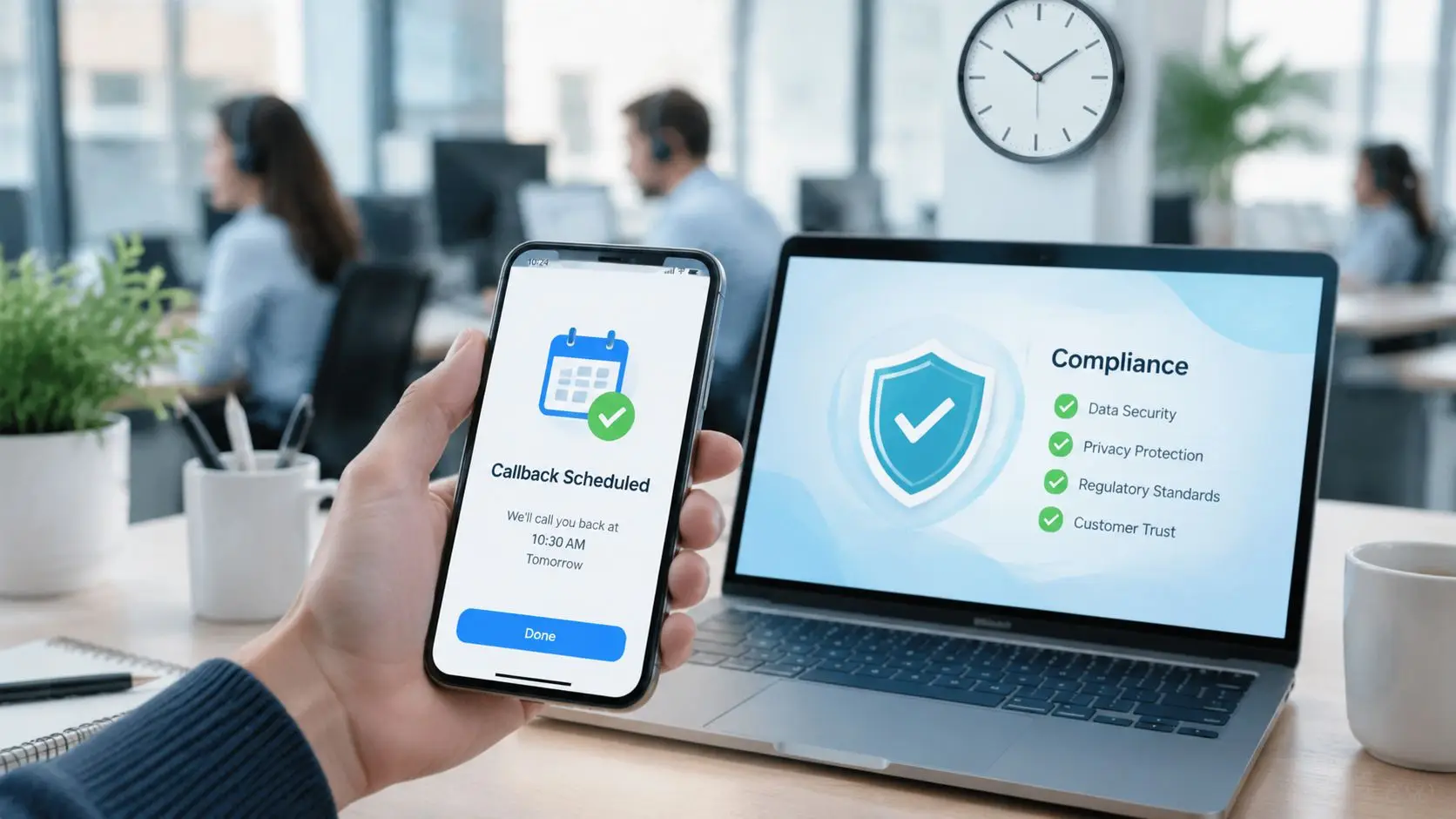
The queue is backing up, the phones are still ringing, and someone on the team is promising to call people back "later." That sounds harmless until the missed contact turns into an abandon problem, a complaint, or a record that nobody can defend in an audit.
In regulated contact centers, a callback is not a courtesy note. It is a controlled workflow with timing rules, ownership, consent handling, and a paper trail that has to hold up under TCPA, HIPAA, FDCPA, and internal quality review. The teams that treat it like a loose promise usually end up with the same three problems, inconsistent customer experience, avoidable compliance risk, and no reliable way to prove what happened.
A scheduled callback should start with operations, not courtesy. If the center is trying to reduce hold time, manage surge volume, or stop abandonment from eating service levels, the callback becomes a queue-control mechanism with a measurable purpose.
That's the practical difference between a real workflow and an agent scribbling a note. Callback scheduling is a measurable workforce and queue-management mechanism used to control abandon rates and match demand to staffing, and experts recommend piloting the workflow by watching AHT, connection rate, and SLA hit rate before rollout (NiCE guidance).
An agent who says, "Someone will call you back," without a controlled process creates three problems at once. First, the customer has an expectation that may never be tracked. Second, the callback may happen outside an approved window. Third, there is no clean record tying the request to consent, queue ownership, and outcome.
That matters in collections, healthcare billing, insurance claims, and public service environments where contact timing and documentation are not optional. If the callback is supposed to reduce abandonment, it has to be offered while the customer is still engaged and before the center loses the contact entirely.
Practical rule: If the callback cannot be assigned, timed, and audited, it is not a callback workflow. It is just a note.
A disciplined center treats the request like a work item. It is captured, routed, scheduled, monitored, and closed. That is the only way to know whether the process is improving response-time performance or just pushing the same problem downstream.

A callback entry point should filter for intent, not collect noise. In regulated environments, the best place for that decision is after authentication and self-service, because the customer has already been identified and the queue is reserved for higher-intent contacts, as noted in Mindful guidance.
That order carries real operational weight in healthcare revenue cycle work. A patient calling about a statement, a payment plan, or an eligibility issue should not be offered a callback before identity is confirmed and the self-service path has been tried. If the center schedules contacts before qualification, it burns staff time and leaves the record harder to defend.
Consent has to be explicit, readable, and attached to the request. A callback request should state what is being scheduled, which number will be used, and what timeframe applies. In TCPA-sensitive environments, the record has to survive review, not just sound reasonable to the person who took the call.
The cleanest pattern is straightforward. Authenticate first, offer self-service next, present the callback option with clear terms, then capture the number and consent flag in the same transaction. That creates a closed loop instead of a vague promise.
Teams that need to formalize that step should tie the operational side of consent management directly to the callback path. If consent sits in one system and scheduling sits in another, the audit trail weakens quickly.
The language should tell the customer exactly what happens next. It should not read like marketing copy, and it should not leave room for interpretation. In healthcare RCM, a workable script is, "A representative will call you back within the available scheduling window at the number you confirm now."
A callback request should feel like a controlled handoff, not a favor. Precise language gives compliance teams less to clean up later.
Public-facing scheduling also needs the same discipline. If your team has to manage your public schedules, the callback entry point should match the availability rules already approved for that channel, so the promise made in the workflow matches the window the operation can honor.
The operational goal is direct. Qualified contacts get scheduled cleanly, unqualified contacts stay out of the queue, and every request leaves a documented trail showing what was offered, what was accepted, and what was entered.

A callback engine needs guardrails because the workflow has to match what the center can deliver. Some enterprise systems default the callback to 30 minutes after the current time and do not allow scheduling more than 30 days in advance, with routing options that can send the callback to a queue, the original queue, or the agent who created it (Genesys schedule-a-callback documentation). Those limits are useful because they keep the process inside controllable boundaries.
That kind of structure matters in regulated operations. A center that accepts open-ended scheduling can drift into promises the staff cannot honor, while a bounded scheduling horizon lets supervisors align callback commitments with staffing, queue depth, and service-level targets. If the logic is loose, the calendar fills with requests that look valid on the front end and fail in the queue.
Callback data should not be flexible in the wrong places. A strong workflow needs a single phone number, an explicit timestamp, and queue-time rules that determine what happens if the callback cannot be delivered as scheduled.
That means no multi-number record with ambiguous dial targets. It also means the callback time should be stored in a standardized format, because loose date handling is how appointments get misread across systems and time zones. If the queue cannot absorb the request, the overflow policy has to be defined up front, not left to the agent's judgment. A regulated contact center also needs the scheduling path to line up with Intelligent Contacts contact center scheduling so the rules in the front end match the controls in the operation.
A strong scheduling engine knows when to stop accepting requests for a slot. It should reflect agent skill, language group, queue priority, and service line capacity, not just a generic calendar view. That logic belongs to operations and workforce planning, not to a loose front-end form.
For teams that also manage public-facing appointment calendars, manage your public schedules can be a useful reference point for thinking about window discipline and user-facing availability. The point is straightforward. If the calendar is overbooked or inconsistent, the promise fails.
The internal scheduling layer should also be mapped to the center's routing rules. A callback can go back to the original queue by default, or it can be assigned to a specific skill group or agent when the case demands continuity. That keeps the process aligned with service ownership instead of turning it into a generic bucket of deferred work.

A callback request that sits outside the system of record creates avoidable risk. In a CRM or EHR-driven environment, the scheduler should write the request into the same record that already holds the contact history, case status, and outcome notes.
The data model has to stay disciplined. It should enforce a single phone number, store the callback timestamp in a standard format like MM/DD/YYYY HH:MM:SS, and define the overflow rule before the queue gets tight. Otherwise agents end up making judgment calls that weaken the audit trail.
The CRM or EHR should capture the source of the request, the consent status, the selected callback time, and the final disposition after the call is completed. That gives the outbound agent the full context in one place instead of forcing them to reconstruct the interaction from separate systems.
That matters in financial services and healthcare. If a patient or account holder later disputes the timing of the contact, the center needs a record that shows when the callback was requested, who approved it, and how the request was handled.
The lifecycle should move through a small number of clear statuses, requested, scheduled, attempted, completed, rescheduled, or cancelled. More codes can look precise on paper, but they often create confusion unless each one triggers a distinct operational action.
For centers building a tighter integration path, an example of integrated CRM call centre software shows how contact history, dialing, and scheduling can sit against one record instead of being spread across disconnected tools. That kind of design reduces the chance that agents work from stale information.
Operational warning: If the callback record can be edited without a trace, the audit trail is already compromised.
The better integration pattern leaves no doubt about ownership. The request enters the record once, the schedule stays tied to the approved window, and every later action remains visible to supervisors, quality teams, and compliance reviewers.
A callback is not finished when it's scheduled. The work begins after the request is captured, because the customer still needs confirmation, a reminder, and a clean way to reschedule or cancel if circumstances change.
That is where the workflow stops being a promise and starts being a managed appointment. Mature platforms are pushing callbacks into that model with confirmations and rescheduling, which shows how the feature is evolving beyond a simple "call me later" function (Zoom support overview).
The first message should confirm that the request was received, what time was selected, and how to change it if needed. A reminder should follow before the callback time, especially in high-noise environments like healthcare billing or collections, where the customer may forget or move on.
The language should stay direct. It should tell the customer that the callback is scheduled, not imply that someone will try later without commitment. If the workflow supports SMS and email, both channels should use the same record so the customer never gets two conflicting messages.
A missed callback wastes agent time and breaks trust. It also creates a second contact event that often gets handled under pressure, which is where mistakes happen.
The reminder is not just customer service. It protects the schedule, keeps the promise visible, and reduces the chance of a no-show. In regulated environments, that matters because an unkept appointment can become a documented complaint if it leaves the customer without a clear next step.
A strong lifecycle also includes clean cancellation and rescheduling paths. If the customer can change the appointment without calling an agent, the center avoids unnecessary inbound volume. If the reschedule lands in the same auditable record, the compliance team keeps the trail intact.
If the callback process cannot be measured, it will drift. The center needs to know whether the workflow is reducing abandonment, improving connection rates, and staying inside the staffing model that was approved in the first place.
The cleanest answer comes from treating callback performance as a queue metric, not a vanity metric. Scheduled callbacks deserve their own reporting view, and the platform should show whether the process is helping the center meet service goals instead of creating hidden work (Genesys scheduled callbacks view).
The most useful measures are the ones that tie back to operations. Teams should watch how many requests are scheduled, how many are completed on time, how many are rescheduled, and how often the callback path reduces avoidable holds or abandons.
In healthcare and collections, the critical question is not whether the feature exists. The question is whether it improves outcomes or just shifts work into another queue. That is the same tension raised in mature callback workflow guidance, which asks whether the process reduces friction or just moves it elsewhere (Zoom support overview).
A good dashboard lets the operations director explain why the workflow exists. If the callback reduces abandon rates, preserves staffed capacity, and creates a documented contact trail, that is measurable value. If it creates rescheduling loops or a pile of missed attempts, the process needs to be adjusted before it becomes a compliance issue.
The best centers review callback performance alongside staffing and contact-rate trends. That gives leadership a realistic picture of whether the process is pulling work out of the live queue or just delaying it.
Best practice: If the callback workflow does not improve control, it needs redesign, not more promotion.
For regulated teams, ROI is only part of the story. The other part is governance. A measurable callback program gives auditors a defensible record that the center handled contact requests under a controlled process instead of ad hoc agent judgment.
A callback system stitched together from separate tools creates gaps at the exact points where regulated teams need control. Scheduling in one place, dialing in another, and payment follow-up somewhere else makes it harder to keep consent, timing, and resolution aligned.
That is why a unified workflow matters. In a single operational flow, the callback request, the outbound contact, and the payment step can stay linked without forcing agents to switch between systems or reconstruct the interaction later. For teams handling delinquency, one useful benchmark is whether the callback can lead directly into a structured recovery path, such as comprehensive AR recovery services, without breaking the record.
When the contact center and payments process share the same system, the audit trail stays tighter. That matters for PCI-DSS, TCPA, HIPAA, and internal quality controls, because the handoff from conversation to resolution is where errors usually appear.
Intelligent Contacts is a unified contact center and payments platform built to keep voice, SMS, email, chat, self-service payments, and callback workflows inside one system. It also supports Grace, the AI collection agent, but the important part here is the workflow control, not the label.
For regulated operations, that kind of structure is the point. The callback is not the end of the interaction, it is the bridge to resolution, and the bridge needs to be logged, governed, and easy to audit.
If your team needs a callback workflow that stays inside consent rules, preserves queue ownership, and connects cleanly to payment resolution, visit Intelligent Contacts to see how the platform handles scheduling, routing, and payments in one controlled process. For a direct conversation about your environment, use the contact options on the site to schedule a demo or see your ROI.