
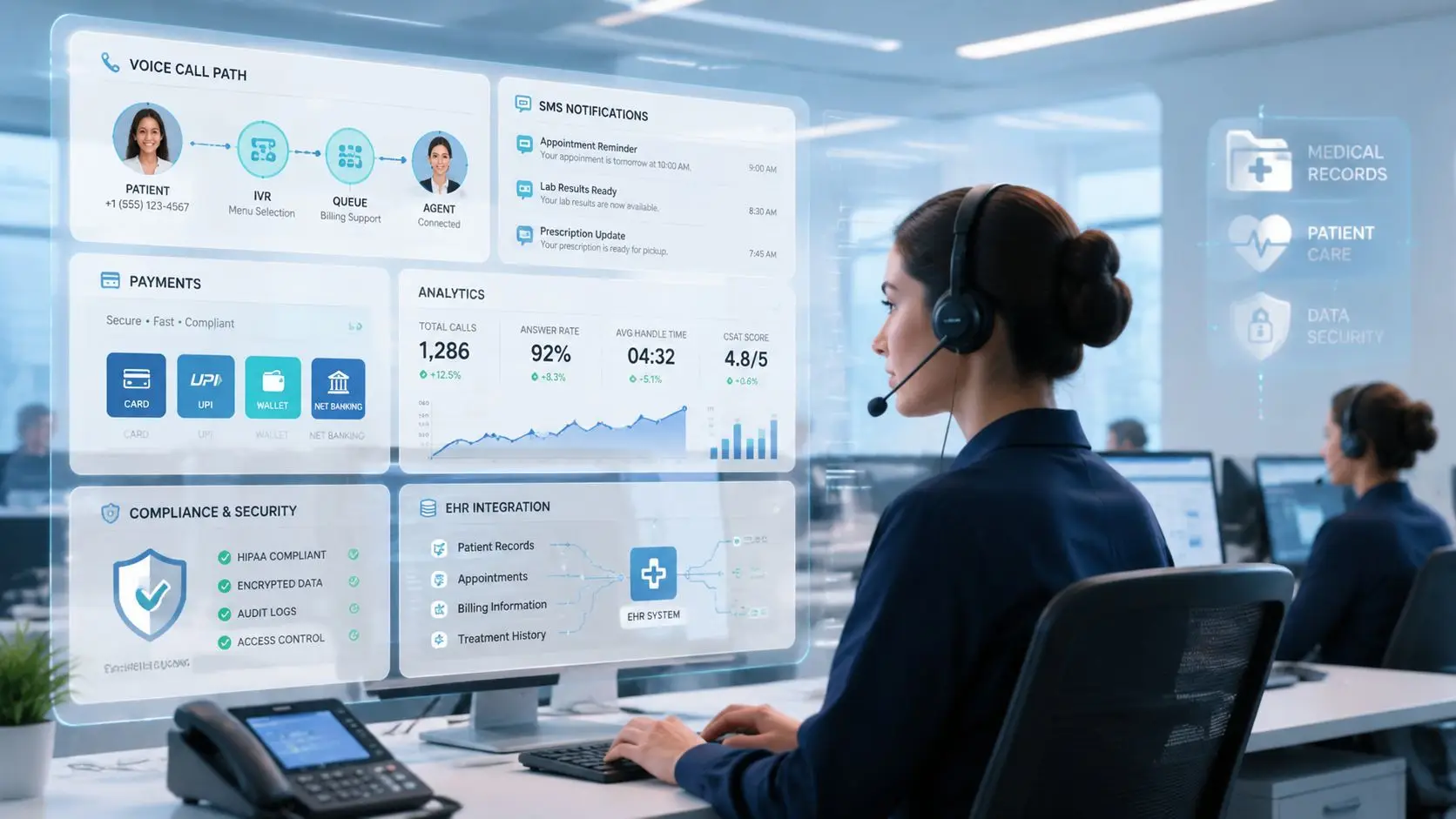
A patient gets a statement, calls the number on the bill, lands in a maze of menu options, waits, gets transferred, then hangs up. Finance loses a payment opportunity. Operations gets another repeat call later. The patient leaves with the impression that the organization is hard to deal with when money is involved.
That's the old model. It treated the healthcare contact center like a phone room.
The current reality is different. Patient communication, billing, payment capture, consent management, documentation, and compliance now sit in the same workflow. If those parts live in separate systems, the friction shows up fast. Agents toggle between screens, patients repeat themselves, and every handoff creates a new risk point.
A modern healthcare contact center isn't just a service function. It's part of revenue cycle operations, patient access, and retention. That shift is one reason the market is expanding so quickly. The global healthcare contact center solution market is projected to grow from USD 11.5 billion in 2025 to USD 65.0 billion by 2035, with a projected 18.9% CAGR and 61.3% cloud adoption in 2025, according to healthcare contact center market projections.
The patient doesn't care how many systems sit behind the interaction. The patient cares whether the issue gets resolved without friction.
That matters most on the financial side. A billing call rarely stays a simple billing call. It can turn into an insurance question, a request for a balance explanation, a payment plan discussion, or a card payment. If the system can't support that full path in one session, the organization creates work for itself.
A disconnected setup usually has the same symptoms:
Practical rule: If a patient has to switch channels or repeat account information to make a payment, the workflow is broken.
The new standard is simple to describe and hard to execute. A patient reaches out on any approved channel, the organization identifies the reason for contact quickly, routes the interaction to the right queue, gives the agent the right context, and offers a secure path to resolution in the same workflow.
That applies to self-service too. A well-designed IVR or SMS flow should handle the straightforward tasks and leave agents to manage exceptions, disputes, and sensitive conversations.
For healthcare leaders trying to improve both collections and experience, the best framing is this: patient engagement doesn't stop at reminders and surveys. It includes the financial interaction, which is why patient engagement is not just a catchphrase in a contact center environment. The front line has to support care communication and payment resolution without forcing patients into separate processes.
A useful platform isn't a pile of features. It's a set of connected functions that reduces effort for both the patient and the team.
Healthcare call centers handle an average of 2,000 calls daily, or about 220 calls per hour during standard operating hours, yet peak staffing meets only 60% of required coverage, leaving a shortfall of 23 agents per center, according to healthcare call center staffing data. That operational pressure changes how every component should be evaluated. The question isn't whether a tool exists. The question is whether it removes work at scale.

| Component | What it should do in healthcare | What fails in practice |
|---|---|---|
| Voice | Route a billing issue to revenue cycle staff, not clinical support | Flat menus and generic queues |
| SMS | Send secure reminders and payment prompts tied to the account | One-way texting with no workflow logic |
| IVR | Handle balance lookup and self-service payments without agent help | Long menus that bury the payment path |
| Outbound dialing | Support consent-aware outreach for statements, reminders, and follow-up | Dialing without rule controls or list hygiene |
| Analytics | Show queue pressure, transfer patterns, and payment-related friction | Dashboards that report activity but not resolution |
| Integrations | Pull account and patient context into one working view | Screen-hopping across disconnected systems |
A healthcare contact center with strong routing logic performs very differently from one with the same channels but weaker workflows. Routing needs to account for intent, urgency, skill, account type, and whether the interaction may involve payment. Otherwise, staff waste time transferring calls while the patient gets more frustrated.
The same principle applies to automation. Self-service works when the organization limits it to clear, repeatable tasks and gives the patient an easy path to a live person when needed. It doesn't work when automation becomes a barricade.
A lot of revenue cycle teams also benefit when communication tools support payment workflows natively. That's one reason many organizations look at ways to accelerate cash flow using RCM automation while reducing manual touches inside billing operations.
Automation should remove routine effort, not hide the organization from the patient.
Compliance isn't the last item on the checklist. It's the architecture.
A single healthcare contact center interaction can involve patient identity, account balance, card data, outbound communication rules, and collection language. When those controls sit in different products, the gaps usually show up in the handoffs. One system stores call data, another sends texts, a third processes payments, and nobody can fully trace the workflow.
Healthcare contact centers must adhere to HIPAA, TCPA, PCI-DSS, and FDCPA concurrently, as outlined in healthcare contact center compliance requirements. That overlap is why piecemeal architecture creates problems even when each individual tool claims to be compliant on its own.

Consider a routine payment reminder and follow-up call:
That's why compliance language has to be precise. A healthcare message exemption under TCPA doesn't create a free pass for billing content. Under the FCC's 2020 TCPA interpretation, healthcare providers may make up to three automated or prerecorded healthcare-related calls per week without prior express consent under defined conditions, and the message must include an automated opt-out and identify the entity and callback number, as summarized in TCPA guidance for conversational AI in healthcare. Separately, TCPA healthcare exemptions do not cover promotional or financial solicitation, and billing or debt collection communications require prior express written consent rather than the lower standard used for non-commercial healthcare messages, according to a healthcare TCPA communication guide.
A compliant environment needs controls that are built into the workflow, not left to agent memory.
For teams reviewing policies and disclosures across vendors and partners, documents like ProMD Health's privacy information are a useful reminder that public-facing privacy practices need to line up with operational reality.
The fastest way to create compliance risk is to let communications and payments live in separate workflows.
Any vendor handling PHI should be able to support a BAA and demonstrate a mature security posture. Teams evaluating healthcare workflows often start with resources on HIPAA-compliant software requirements because compliance in this environment is specific, not generic. A contact center either enforces the rules inside daily operations, or it pushes risk onto agents and supervisors.
Most organizations don't have a communication problem. They have a workflow problem.
Agents can often answer the call, send the text, or document the note. The breakdown happens when the patient is ready to pay and the process jumps somewhere else. A new portal opens. A separate payment vendor takes over. The agent loses visibility. The patient drops out.
That's a serious issue in healthcare revenue cycle management because 68% of healthcare organizations report payment collection as a top barrier to patient access, according to research on healthcare call centers and patient access barriers. The gap isn't just collections performance. It's the fact that many environments still treat payment as an add-on instead of part of the communication workflow.
A native payment flow changes the economics of the interaction.
The agent sees the account context, confirms the balance, handles the patient's questions, and completes the payment in the same controlled session. If the patient prefers self-service, the system should support a secure path without sending the patient into a separate toolset that creates tracking and compliance gaps.
That's where a unified model stands apart from a reseller stack. Intelligent Contacts is one example of a unified contact center and payments platform built in-house, with communications and payment processing in one workflow rather than stitched together from third parties.
For teams focused on patient intake and earlier financial clearance, capturing payment method during patient intake shortens DSO and reduces bad debt because the organization removes friction before the statement ever becomes a collection problem.
A payment workflow only works when communication, account context, and compliance controls all stay intact from start to finish.
Most healthcare contact center projects struggle before technology is even selected. Requirements are vague, workflows aren't documented, and nobody has agreed on what success looks like.
The cleaner approach is phased. That keeps the team focused on operating reality instead of demos and feature lists.

Define the business problem first
Start with what's breaking today. Long billing queues, dropped payment opportunities, inconsistent consent handling, weak self-service, poor reporting, or too much agent screen-hopping are all valid starting points. What matters is choosing the problems that have operational and financial consequences.
Audit current workflows and controls
Map the patient journey from statement to payment. Include inbound calls, outbound reminders, SMS, payment handling, escalations, and after-hours paths. This is usually where organizations discover that the documented process and the actual process are not the same.
Evaluate architecture, not promises
Ask whether the system is built in-house or assembled from outside components. A unified platform generally shortens deployment and reduces integration friction. A multi-vendor stack often turns implementation into a coordination project across separate teams, contracts, and support models.
A practical launch sequence usually looks like this:
Implementation moves faster when one provider owns the communication and payment workflow, the integration paths are already defined, and the operating team has made decisions early. It slows down when internal teams are still debating ownership, when multiple vendors need to coordinate changes, or when compliance review starts after configuration is finished.
A practical benchmark is readiness, not calendar ambition. If the workflow, approvals, and integrations are clear, some platforms can be implemented in days rather than dragging into a long custom project.
The business case for a healthcare contact center shouldn't rely on generic efficiency language. Finance leaders want to know what changes in cost-to-collect, self-service adoption, payment capture, and outstanding balances.
That means measuring the contact center as part of revenue cycle performance, not as an isolated service desk.
A workable scorecard usually includes:
The math doesn't need to be complicated. Compare current-state labor and payment friction against the projected state after implementation.
| ROI area | Current-state question | Improvement question |
|---|---|---|
| Labor load | How much agent time goes to routine billing and payment tasks? | How much can move to self-service or better routing? |
| Payment completion | How often does a payment conversation break before completion? | How many of those can finish in the same session? |
| Collections speed | How long do balances sit before action happens? | Can earlier outreach and easier payment reduce that delay? |
| Compliance overhead | How many manual checks exist across communication and payment workflows? | Can the platform enforce more of those controls natively? |
“The results that matter aren't cosmetic. Leadership wants to see fewer payment handoffs, cleaner workflows, and more dollars collected without adding headcount.”
Many teams overvalue handle time and undervalue resolution. A short call that ends with no payment, no documented next step, and a likely repeat contact isn't efficient. It's deferred work.
The stronger financial case comes from connecting workflow design to revenue outcomes. Better self-service reduces routine load. Native payment capture removes drop-off. Cleaner routing puts the right staff on the right work. Those changes don't just make operations easier. They make the revenue cycle more predictable.
Vendor selection usually breaks down in the demo. A billing call looks clean until the patient needs to pay, the workflow jumps to another tool, and no one can show exactly how the account update is written back. In healthcare, that gap creates compliance risk, delays cash, and adds repeat work for agents.
The checklist needs to test one thing above all: whether communications, secure payment processing, and documentation run as one controlled workflow.

A healthcare contact center platform should be able to produce its HIPAA documentation, Business Associate Agreement, encryption controls, audit logging approach, and independent security attestations without delay, as noted earlier. If those answers come back vague, the evaluation should stop.
The same standard applies to payment security. If communication tools and payment tools sit in separate systems, ask who owns scope, logging, access control, and dispute research across the handoff. That answer affects more than compliance. It affects agent effort, payment completion, and how quickly staff can resolve a patient issue in one interaction.
If a vendor cannot show the workflow, the controls, and the implementation path clearly, the platform likely depends on workarounds your team will inherit.
A strong healthcare contact center partner answers operational questions in plain language and proves the details in a live workflow.
Intelligent Contacts brings communications and payments into one workflow for healthcare, collections, financial services, insurance, government, utilities, and other regulated environments. Teams that need a healthcare contact center built around compliance, revenue cycle performance, and fast implementation can Schedule a Demo or See Your ROI. For direct questions, contact Intelligent Contacts through the website contact options to discuss integration paths, go-live timelines, and secure payment workflows.