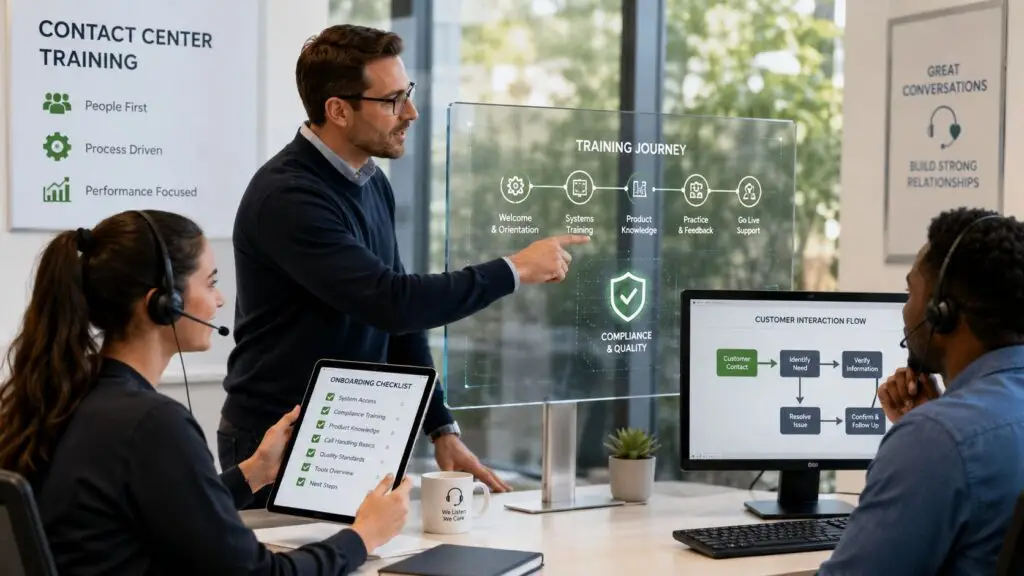
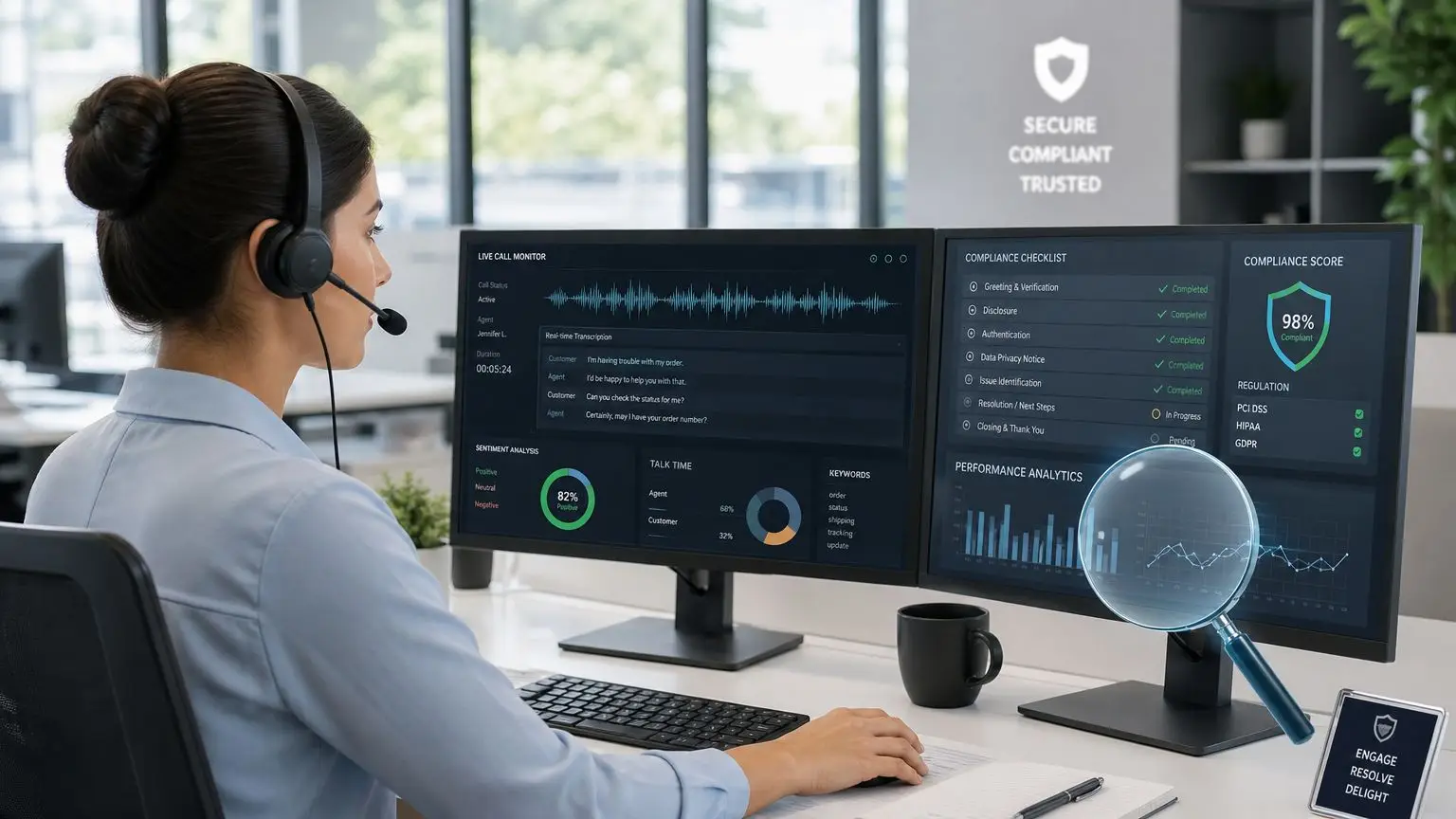
Many teams are already familiar with this pattern. A compliance issue gets found three days late. A supervisor pulls a recording, QA marks the failure, and everyone acts surprised even though the same mistake probably happened across dozens of conversations before anyone reviewed the first one.
That approach breaks under modern volume. The average call center handles roughly 4,400 calls per month, and 61% of leaders report higher call volumes than in previous years. Consistent monitoring is also tied to 15% higher agent productivity and a 20% increase in customer retention according to these call center statistics. In other words, call center call monitoring isn't a back-office checklist anymore. It's part of how operations controls risk, labor, and customer outcomes.
In regulated environments, the consequences are significant. A missed disclosure under the FDCPA, an exposed card detail under PCI-DSS, or mishandled PHI under HIPAA isn't just a coaching issue. It's evidence. Teams that still treat monitoring like a weekly scorecard review are leaving blind spots where violations, rework, and agent inconsistency pile up.
The shift is simple. Monitoring has moved from sampling to control. The teams getting value from it are using it to detect risk early, coach on behaviors that change outcomes, and route supervisor attention where it matters most. That shift gets a lot clearer when speech analytics is creating fully compliant and highly effective contact centers instead of just producing more transcripts no one reads.
Old-school QA was built for a different contact center. A manager listened to a handful of calls, filled out a scorecard, and hoped the sample reflected reality. In a low-volume environment, that was limited but workable.
In regulated operations, it isn't enough anymore.
A sampled review tells a team what happened on a few calls. It doesn't tell them what is happening now, whether the same failure is spreading, or which agents need intervention before the next queue spike. That gap matters in collections, patient billing, banking, insurance, and public sector service where one scripting miss can become a pattern fast.
Three failures show up over and over:
Practical rule: If monitoring only tells a supervisor what went wrong last week, it isn't controlling operations. It's documenting drift.
The scorecard isn't dead. It still matters for calibration, coaching, and documenting expectations. What changed is its job.
Now the scorecard should sit inside a wider monitoring system that captures every interaction, flags exceptions, and pushes human reviewers toward the calls that need judgment. That's a much stronger model than random listening, especially when service levels are under pressure and compliance exposure isn't optional.
Call monitoring became a formal quality discipline as recording and playback matured, but the biggest operational change came when teams stopped treating monitoring as manual listening and started treating it as an always-on review layer. Modern practices use speech and conversational analytics to examine large volumes of interactions, and automatic scoring changed the process from a sampled audit to a system that can review every call at scale, as explained in Qualtrics' overview of call center monitoring.
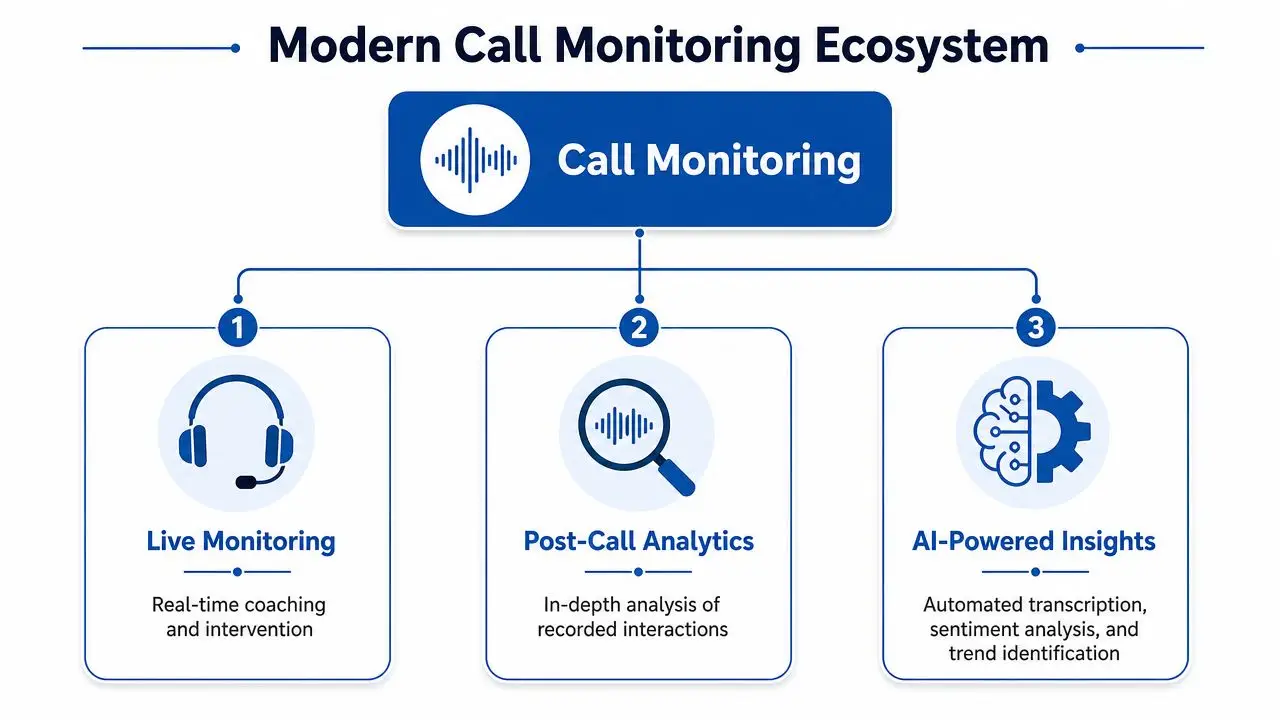
Most serious call center call monitoring programs now rest on three connected layers.
| Component | What it does | Why it matters |
|---|---|---|
| Live monitoring | Shows current call volume, wait times, and agent availability | Supervisors can intervene before service levels fall apart |
| Recording | Creates a complete record of interactions | Teams can audit, investigate, and coach from the actual conversation |
| Analytics | Finds risk, patterns, and opportunities across all interactions | Human review gets directed to the calls that deserve attention |
Each part solves a different problem. Live monitoring helps operations. Recording supports evidence and traceability. Analytics makes scale possible.
Modern platforms act as real-time control systems. They combine live monitoring, 100% call recording, and automated analysis to surface issues such as long hold times or policy violations as they happen rather than after the fact, according to this guide to call center monitoring software.
That sounds obvious, but a lot of teams still miss the implication. Once a center can monitor continuously, supervisors shouldn't spend most of their time hunting for calls to review. The system should surface the calls that need action.
Monitoring works best when machines do the sorting and people do the judgment.
A few habits hold teams back:
The better operating model is straightforward. Capture everything. Score automatically. Escalate exceptions. Coach on behaviors tied to outcomes.
For regulated contact centers, monitoring isn't a nice-to-have process layered on top of operations. It's part of the control environment. If a center handles collections, payments, healthcare conversations, or account servicing, the monitoring design has to reflect the rules that govern the interaction itself.

Generic statements about security don't help. The operating question is what the system must do differently because of the regulation.
A center that bolts these checks on after deployment usually ends up with workarounds. Workarounds fail audits.
Voice is only part of the surface area. Credential theft, account takeover attempts, and exposed personal data can also enter through adjacent channels. Security teams that want a fuller picture often pair interaction monitoring with resources for monitoring for stolen credentials, especially when customer identity verification and account access are part of the workflow.
The same principle applies inside the contact center stack. Recording policy, transcript access, payment handling, retention rules, and user permissions should all sit inside a defined security model. Teams that need a practical baseline usually start with a review of contact center security requirements.
A compliant recording policy is useless if access to the recording is sloppy.
The failures are usually ordinary, not dramatic.
The best monitoring programs treat compliance like a workflow. Detect. document. escalate. coach. retest.
Metrics matter when they change decisions. Too many monitoring programs collect data that looks useful in a dashboard but doesn't help a supervisor decide whether to coach an agent, fix a process, or escalate a compliance concern.
For regulated contact centers, the monitoring data points that consistently matter most are AHT, FCR, QA score, and compliance adherence because they connect agent behavior to cost, resolution quality, and regulatory risk, as outlined in this call center monitoring guide. The point isn't to admire the numbers. The point is to connect them to root cause.

AHT on its own can mislead. A shorter call isn't better if the customer calls back, the promise to pay wasn't captured correctly, or the disclosure got skipped. FCR on its own can mislead too if agents are rushing customers off the line and coding outcomes too generously.
A better read looks more like this:
The scorecard should reflect what the center is trying to control. That usually means a mix of service, process, and compliance behaviors rather than a long script checklist.
A practical scorecard often asks:
The best QA form is short enough to use consistently and specific enough to support coaching.
Data without follow-up becomes noise. Supervisors need a way to move from flagged interaction to coaching note to measured improvement. That usually means short review cycles, calibration between leaders, and scorecards that agents can understand.
Teams looking to tighten that feedback loop usually end up redesigning both QA forms and manager workflow at the same time. A practical starting point is a tighter contact center quality management approach that links monitoring findings to coaching and compliance review instead of treating them as separate functions.
Monday at 9:15 a.m., a supervisor has 40 flagged calls, two agent absences, a complaint in the queue, and a compliance manager asking for proof that revocation language was handled correctly. That is a critical implementation test. Modern call monitoring has to help the operation decide what needs attention now, what can wait, and what must be documented before the regulator or client asks.

The shift is operational. Monitoring used to mean reviewing a small sample for QA scores. Now it needs to act as a control system across every interaction, routing risk to compliance, coaching to team leads, and process defects to operations. If that routing model is missing, full-call analysis just creates a larger backlog.
Start with the decisions the business needs to make. A collections team may care first about Mini-Miranda delivery, cease and desist language, dispute handling, and payment authorization. A healthcare team may need to catch identity verification failures, missing consent language, and possible PHI exposure. A bank servicing group may focus on call recording consent, complaint language, authentication breakdowns, and commitments the next team has to honor.
That leads to a practical rollout sequence:
Human review capacity is usually the constraint. Supervisors cannot investigate every silence gap, script miss, and soft-skill issue on top of attendance, escalations, and schedule coverage. Triage has to be built into the workflow.
A workable queue usually separates events into three buckets:
The trade-off is simple. Tight thresholds catch more risk but create more review work and more false positives. Loose thresholds reduce noise but let preventable failures through. Operations leaders need to set that tolerance deliberately, especially in regulated environments using secure unified platforms for financial compliance, where the monitoring layer has to support auditability as much as coaching.
A few mistakes show up in almost every rollout. Teams launch with a scorecard that is too broad, so calibration falls apart. They send every alert to supervisors, so urgent issues get buried with minor misses. Or they position monitoring as a disciplinary tool, and agents quickly learn to hide problems instead of surfacing them.
Keep the first implementation narrow and unforgiving about ownership. Pick the call types that create the most exposure. Define who reviews what within what timeframe. Then test whether the workflow reduces complaints, rework, and compliance exceptions.
One practical option for teams that need communications, analytics, and payment workflow in one place is Intelligent Contacts, a unified contact center and payments platform built in-house for regulated environments. The operational benefit is straightforward. Voice, routing, payment handling, and monitoring controls live in the same workflow, so supervisors can review the interaction, the outcome, and the audit trail without piecing together records from separate systems.
Generic call center call monitoring advice falls apart once a team gets into actual regulated workflows. The same dashboard won't answer the same questions for a debt collector, a patient billing team, and a financial services servicing group.
In collections, monitoring has to do more than grade tone and script use. It needs to catch dispute language, promises to pay, revocations, third-party disclosure risk, and whether the agent used required debt collection disclosures correctly.
A useful review pattern in collections usually looks for:
If the operation also takes payments, the monitoring workflow should connect the conversation and the transaction path. That's where unified communication and payment systems matter more than abstract QA categories.
Healthcare billing and patient access teams deal with a different kind of pressure. Identity verification has to be secure. PHI has to stay protected. And the conversation often happens when the patient is confused, stressed, or already frustrated by the bill.
Monitoring in that environment should focus on whether the agent:
The call may be technically compliant and still operationally poor if the patient leaves uncertain about next steps.
These environments often require precise disclosures, controlled authentication, and clean documentation of what the customer agreed to. In financial services especially, monitoring should test whether agents explain terms accurately, avoid improvised language around sensitive account issues, and create a record that stands up later.
Teams evaluating architecture in these sectors often benefit from broader guidance on secure unified platforms for financial compliance, especially when communication, documentation, and policy controls are spread across separate systems.
The same principle applies in insurance claims, government service lines, and utility collections. Monitoring should be tuned to the moments that create legal exposure, customer confusion, or avoidable repeat contact. Everything else is secondary.
Call center call monitoring used to be a scorecard exercise. In regulated operations, that's no longer enough. The primary objective now is to give leaders a control system they can use to catch risk early, direct coaching intelligently, and keep evidence tied to the actual interaction.
That matters most when communication and payment workflows overlap. If the call lives in one system, the transcript in another, the payment record in a third, and compliance review somewhere else, teams create gaps they can't easily defend. A unified model reduces that fragmentation.
The practical advantage isn't hype. It's tighter control over how calls are handled, how exceptions are escalated, and how quickly a team can move from issue detection to corrective action. For operations dealing with TCPA, HIPAA, PCI-DSS, FDCPA, or FCRA pressure, that's the difference between monitoring as paperwork and monitoring as management.
Intelligent Contacts brings communications and payments into one workflow for regulated contact centers. Teams using Intelligent Contacts can manage voice, SMS, email, chat, self-service payments, routing, analytics, and compliance controls inside a single in-house platform built for collections, healthcare revenue cycle, financial services, insurance, government, and utilities. To see how that fits an existing operation, Schedule a Demo or See Your ROI. Contact Intelligent Contacts at sales@intelligentcontacts.com or call 888-783-8917.