
The problem usually shows up before the audit does.
An agent says the wrong thing on a recorded call. A payment lands in one system but the recording sits in another. A customer insists consent was never given. Compliance asks for proof, operations pulls reports from four platforms, and nobody trusts that the final timeline is complete. That's how call center compliance fails in practice. Not because people didn't care, but because the operation was built with too many gaps.
For leaders in collections, healthcare revenue cycle, financial services, insurance, government, and utilities, compliance pressure never turns off. TCPA, HIPAA, PCI-DSS, FDCPA, and FCRA aren't background noise. They shape scripts, workflows, access controls, recordings, payments, staffing, and audit response. The organizations that handle this well don't treat compliance as a legal binder on a shelf. They treat it as operating architecture.
Teams often begin with the wrong mental model. They think compliance belongs to legal, quality assurance, or a dedicated officer. Then a complaint comes in, and the issue lands on operations, IT, training, analytics, and finance all at once.
That's because call center compliance is an execution problem before it becomes a legal one. If an agent can't see a clean consent record, the script won't save the call. If call recordings capture payment data they shouldn't, policy language won't fix the audit trail later. If customer history is split across platforms, managers can't prove what happened with confidence.
In regulated environments, ordinary events create compliance exposure:
None of that feels theoretical when a regulator, client, or internal audit team asks for documentation by end of day.
Operational truth: Every compliance rule eventually becomes a workflow rule, a system rule, or a reporting rule.
The strongest teams don't chase perfection. They build repeatable control. They know where consent lives, how call recording works, what an agent can access, when payments leave the spoken channel, and how to reconstruct an interaction without asking five departments to compare notes.
That shift matters. When compliance is built into routing, scripting, recording, payment handling, and reporting, the organization stops reacting to every issue like a fire drill. It starts operating with evidence, not assumptions.
A complaint hits at 4:30 p.m. Legal wants proof of consent. Operations needs to know whether the call should have happened at all. The answer is buried across the CRM, dialer, QA platform, recording system, and a spreadsheet someone in marketing exported three weeks ago. By the time the team pieces the record together, the actual problem is already clear. The business does not have a compliance issue in isolation. It has an operating model that cannot produce evidence on demand.
The cost shows up fast. Campaigns get paused. Payment workflows get restricted. Supervisors stop coaching and start pulling logs. Compliance, legal, IT, and operations burn hours on remediation instead of production. Clients notice. Auditors notice. Finance notices when the same incident creates write-offs, outside counsel spend, and missed revenue in the same month.

Outbound communication failures usually start as data and workflow failures, not agent misconduct. Consent is captured in one system, imported into another, filtered by a third, and acted on by a dialer that may not share the same logic. Once that happens, the organization loses control of something basic. It can no longer prove who was contacted, why they were eligible, whether the timing was permitted, and how an opt-out was enforced.
That gap has direct financial impact. A disputed outreach record can stop a campaign, trigger manual suppression reviews, and force rework across sales, marketing, and compliance. In collections and ARM environments, weak controls around right-party contact, call timing, and call handling also weaken legal defensibility. The issue is not just whether a rule was violated. The issue is whether the center can reconstruct the event with records that hold up under scrutiny.
Privacy failures spread wider than communication failures because they affect storage, access, retention, reporting, and vendor management at the same time. A recording consent problem can become a retention problem. A retention problem can become a data access problem. A data access problem can become a client reporting problem by the end of the day.
For teams handling regulated customer data across regions, storage location adds another layer of exposure. Requirements tied to residency, transfer, and access rights are operational constraints, not abstract legal footnotes. Teams responsible for managing data location for GDPR already know the hard part is not writing the policy. The hard part is making sure recordings, transcripts, analytics, backups, and exports all follow the same rule set.
A practical breakdown of these failure points is covered in how to recognize hidden compliance landmines in your contact center.
A center can survive a tough audit. It struggles to survive an audit that exposes broken handoffs, conflicting records, and systems that cannot produce a clear chain of evidence.
Payment calls change the risk profile of an interaction immediately. If card data can enter a recording, a transcript, an agent desktop, or a screen capture, the business has already expanded its audit scope and its liability. I have seen teams spend months tightening scripts and retraining agents when the underlying problem was system design. The architecture still allowed sensitive data to flow into places it never should have reached.
That is why payment compliance failures are expensive. They drive remediation projects across telephony, recording, QA, security, and reporting. They also expose a larger weakness. Fragmented systems turn a contained payment event into a cross-platform evidence problem, where every team holds part of the answer and nobody owns the full control path.
| Risk category | What auditors look for | What failure looks like |
|---|---|---|
| Communications | Consent records, call timing, opt-out handling, DNC controls | Disputed outreach, weak evidence, campaign interruption |
| Data security | Recording consent, data purpose, access controls, storage discipline | Privacy complaints, remediation work, regulatory exposure |
| Payments | Redaction, encryption, tokenization, secure storage controls | PCI violations, expanded audit scope, insecure recordings |
An audit rarely falls apart because a policy document is missing. It falls apart when an agent follows one screen, the dialer follows another, the recorder captures what it should not, and nobody can prove which control governed the interaction.

The centers that hold up under scrutiny build controls into the workflow itself. Agents should not have to remember which disclosure applies, whether a revocation already came in on another channel, or when a payment step changes what can be recorded. The system has to make the compliant path the default path.
A stored consent record is not an operating control. It becomes a control only when routing, dialing, suppression, and recording behavior all use the same current record.
That record needs to answer a few plain questions without forcing a supervisor to pull exports from three systems:
If those answers are split across platforms, the contact center is relying on reconciliation. Reconciliation is slow, expensive, and hard to defend once a regulator asks for proof tied to a specific interaction.
Payment calls need system controls that stop card data from entering recordings, transcripts, screen captures, and agent notes in the first place. PCI programs usually reduce risk by using controls such as pause-and-resume recording, real-time redaction, tokenization, encryption, and segmented payment capture so sensitive card data does not spread through the environment.
That matters for cost as much as compliance. Once card data lands in recordings or desktops, audit scope expands, more teams get pulled into remediation, and every review cycle takes longer because security has to inspect more systems.
A workable payment control set usually includes:
For teams with cross-border obligations, storage design matters too. managing data location for GDPR becomes an operating issue once recordings, transcripts, and customer records sit in different regions under different retention rules.
Weak authentication creates avoidable exposure fast. One agent discloses account details to the wrong person, and the center now has a privacy problem, a complaint problem, and a documentation problem.
Identity verification has to be standardized across teams and channels. The workflow should define what information can be discussed after basic verification, what triggers step-up verification, how failed attempts are handled, and how exceptions are logged for review. If one team uses DOB and postcode, another uses recent transaction history, and a third lets agents decide, the center does not have a control. It has local habits.
Manual QA still has a place. It helps with coaching and trend review. It does not give leaders enough visibility into regulated interactions at scale, especially when agents are under handle-time pressure or dealing with upset customers.
Monitoring should map to specific control failures, not generic scorecards:
Technical controls need the same operating discipline. Access logs, retention settings, recording rules, and permission changes should be reviewed as part of day-to-day risk management, not saved for annual audit prep. Teams that want a stronger baseline should start with tighter contact center security controls tied directly to recording, storage, and access behavior.
Most compliance discussions focus on policies, agent training, or audit response. The bigger problem is often structural. Fragmented systems create blind spots that no amount of policy language can fully cover.

A disconnected stack usually looks manageable on paper. One system stores customer records. Another handles dialing. Another records calls. Another processes payments. Another tracks quality. Each tool performs its own task. The trouble starts when compliance requires a single chain of proof across all of them.
A few examples are enough:
That's not a training problem. It's a governance gap.
When managers have to compare records across systems, they're already in a weak position. Reconciliation is slow, inconsistent, and hard to defend under scrutiny. Agents feel this too. They swivel between screens, repeat work, and rely on notes that may never be normalized into a clean audit trail.
“My biggest fear isn't one system failing. It's the gap between systems, where data goes blind and compliance becomes a guess.”
That observation is common in high-volume regulated environments because fragmented architecture turns ordinary work into exception handling.
A unified stack changes the shape of the problem. Consent can drive dialer behavior. Recordings can attach automatically to the right account. Payment handling can be separated from sensitive audio. Supervisors can review one timeline instead of rebuilding one. That doesn't remove the need for governance, but it gives governance something solid to control.
A regulator asks for proof of consent, recording status, and supervisor action on a disputed call. The team knows the customer was handled correctly. Then the scramble starts. One manager pulls QA notes, another checks the recording system, operations looks for the policy version in effect that week, and nobody can produce a clean timeline in the first hour. That is not a documentation problem. It is a culture problem, and it gets expensive fast.
Technology sets guardrails. People decide whether those guardrails hold under pressure.

If policy sits with legal, workflows sit with operations, system settings sit with IT, and QA sits somewhere else, the contact center will drift. It always does. Agents get mixed instructions, supervisors make exceptions to hit service levels, and nobody can say which rule interpretation controls production.
One accountable function needs to own the full chain. That means interpreting the rule, translating it into agent behavior, approving the system logic, and checking that the control still works after script changes, campaign changes, or process updates. In strong operations, this role is close enough to the floor to understand handle time and conversion pressure, but senior enough to stop a bad practice before it spreads.
That owner should be measured on two outcomes. The operation stays compliant, and the operation stays workable.
Annual training satisfies a calendar. It does not control live behavior.
Agents need coaching tied to current scripts, current call types, current objections, and current system prompts. If the process for obtaining consent, pausing recordings, handling payment details, or honoring an opt-out changes, the production workflow has to change with it. A slide deck update is not enough. QA forms, prompts, routing logic, and supervisor scorecards need to reflect the same standard or the floor will revert to habits.
I have seen the same pattern repeatedly. A center invests in policy training, then leaves supervisors to coach from memory while agents work across disconnected tools. Error rates climb because agents are not just remembering rules. They are translating rules in real time while trying to keep calls moving.
A stronger training culture usually includes:
Audit readiness should show up in ordinary work, not only when leadership gets nervous.
The cleanest teams treat documentation, exception handling, and supervisory review as operational discipline. If an agent deviates from a required disclosure, there is a record of what happened, who reviewed it, what correction was made, and whether the process itself needs to change. If recording consent is required, the answer is captured in a way that can be retrieved later and tied to the interaction it governs. If a payment step requires recording controls, the control is triggered consistently and checked in QA.
Culture and architecture intersect. Teams do not build consistent habits in a fragmented environment for long. If agents have to remember which screen holds consent status, which system pauses recording, and where to log an exception, compliance turns into a memory test. A unified platform changes that. It puts the required action inside the workflow, gives supervisors one record to review, and reduces the manual effort that usually hides early warning signs.
The strongest compliance cultures are rarely dramatic. They produce clear records, consistent coaching, fewer exceptions, and fewer expensive surprises.
An audit rarely starts with the violation that triggered it. It starts with a basic request. Show the consent record. Show who accessed the account. Show how the payment interaction was handled. If those answers live in three systems and two spreadsheets, the problem is already bigger than compliance. It is an operating model that cannot defend itself under scrutiny.
Use this checklist the same way an auditor or regulator would. Every "no," "not sure," or "it depends" points to a control gap, extra manual work, and avoidable financial risk.
Teams that pass audits consistently do not rely on heroic cleanup work. They reduce the number of places where records can break, disappear, or contradict each other. That is why many operations eventually move toward one unified AI-powered platform instead of trying to patch compliance gaps with more reviews, more exports, and more exceptions.
A payment dispute lands on a supervisor's desk. The call recording sits in one system, the consent record in another, the payment event in a third, and the agent notes do not match any of them. At that point, the compliance problem is already an operating problem. Every handoff adds delay, rework, and room for error.
That is why call center compliance becomes an architecture decision long before it becomes an audit finding. Fragmented stacks create conflicting records, broken permission models, and incomplete timelines that force teams to patch together evidence after the fact. The direct cost shows up in longer investigations, more escalations, slower complaint resolution, and higher exposure when a regulator, client, or plaintiff's attorney asks for proof.
Payment controls make this plain. Cardholder data and sensitive authentication data should never linger in ordinary agent workflows, stored recordings, or downstream notes. The environment also needs strong encryption for data at rest and in transit, along with system controls that limit unnecessary access and reduce the number of places payment data can spread.
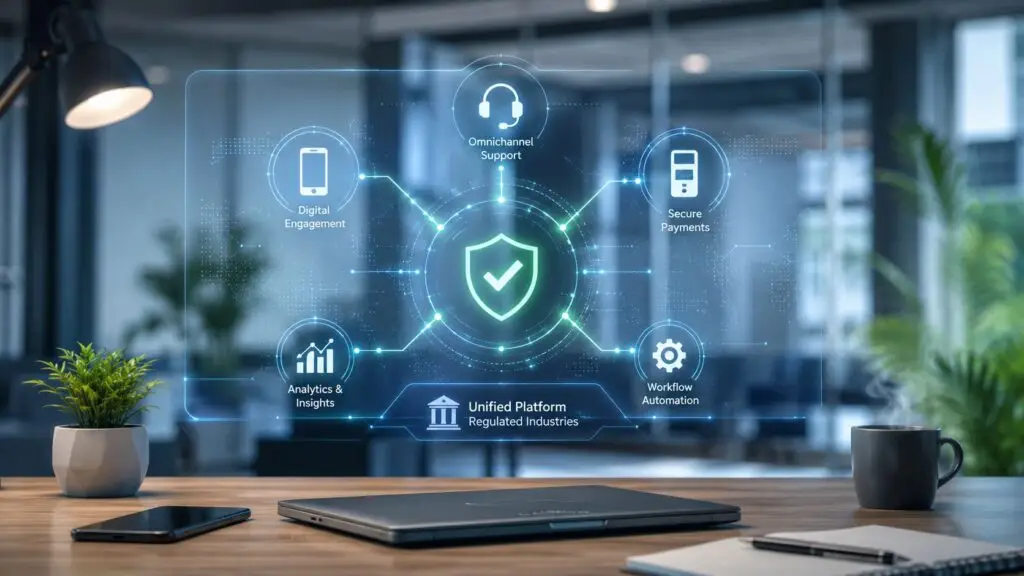
A unified platform fixes the root cause better than another review queue or another exported report. When communications, records, workflows, and payments run in the same operating environment, the business gets one chain of custody, one place to enforce policy, and fewer reconciliation failures. That is the architectural case behind a unified AI-powered platform for contact center operations.
The trade-off is straightforward. Keeping separate systems can preserve legacy contracts or satisfy individual department preferences. It also raises the cost of proving compliance every time something goes wrong.
If the current environment still depends on manual suppression, patched reporting, and disconnected payment handling, the risk is not buried in the fine print. It is built into daily operations.