

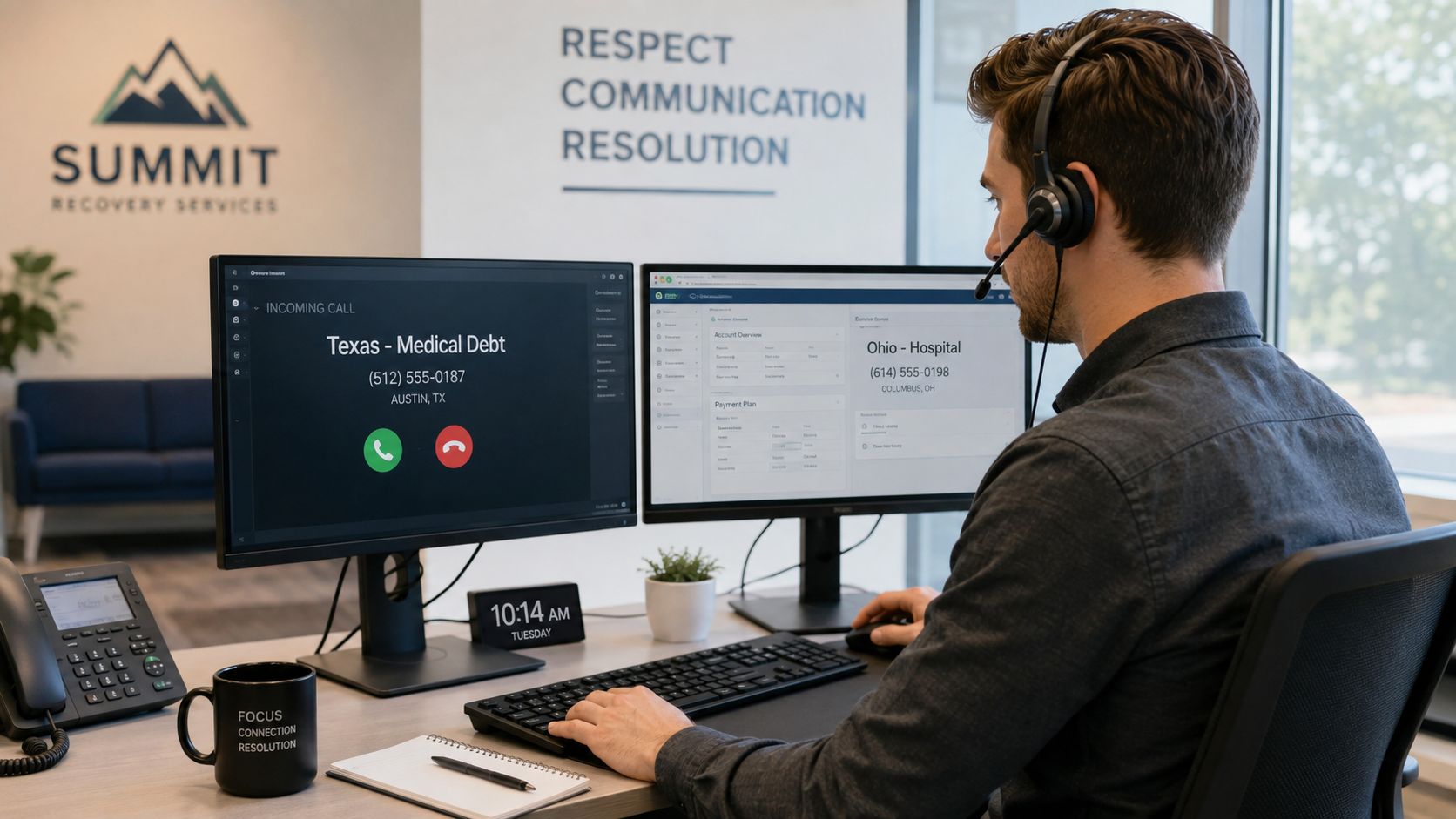
At 10:14 on a Tuesday, two regulated contact centers can face the same operational problem: a caller needs help now, and the next routing decision will determine whether the interaction becomes a payment, a dispute, a complaint, or another abandoned attempt. In collections, the right agent may need the caller's language, account history, settlement authority, and compliance credentials. In healthcare revenue cycle, a patient may need billing, charity-care, prior authorization, or an agent cleared to discuss protected information.
That decision happens before handle time, occupancy, or agent productivity can influence the outcome. Automated intelligent call routing treats the interaction as a live operational and compliance decision, not a transfer from one queue to another.
A borrower calling about a charged-off medical account shouldn't land with whichever collector happens to be available. The system needs to identify the account, check whether contact is permitted at that time and location, confirm the caller's identity, recognize language needs, and select an agent with the authority and training to handle the conversation.
At the same moment, a patient calling a hospital billing line after receiving a confusing explanation of benefits may need a completely different path. Sending that caller to general Tier 1, followed by multiple transfers, creates more than frustration. It can delay payment, increase repeat contacts, and expose information to staff who shouldn't receive it.
A routing engine may evaluate several conditions in sequence:
A static longest-idle rule can't interpret those conditions. It can distribute work, but it can't reliably distinguish a verified right-party contact from an unverified caller, or a payment inquiry from a protected healthcare discussion.
Practical rule: A routing KPI should measure the quality of the first connection, not just the speed of the transfer.
The historical development of this capability explains why the distinction matters. Automatic Call Distributor systems began replacing manual switchboards in the 1960s and 1970s. Rockwell's Galaxy ACD, deployed for Continental Airlines in 1973, is often cited as an early commercial milestone, though similar systems were already running in some call centers before it. Skills-based routing followed, and later routing systems expanded into omnichannel and AI-supported decision-making.
The operational KPI that matters most is first-contact outcome quality. A call that reaches the right person with the right context can resolve an account or billing question. A call that reaches the wrong queue may become a repeat attempt, a complaint, or a compliance review, even if the initial transfer looked efficient.
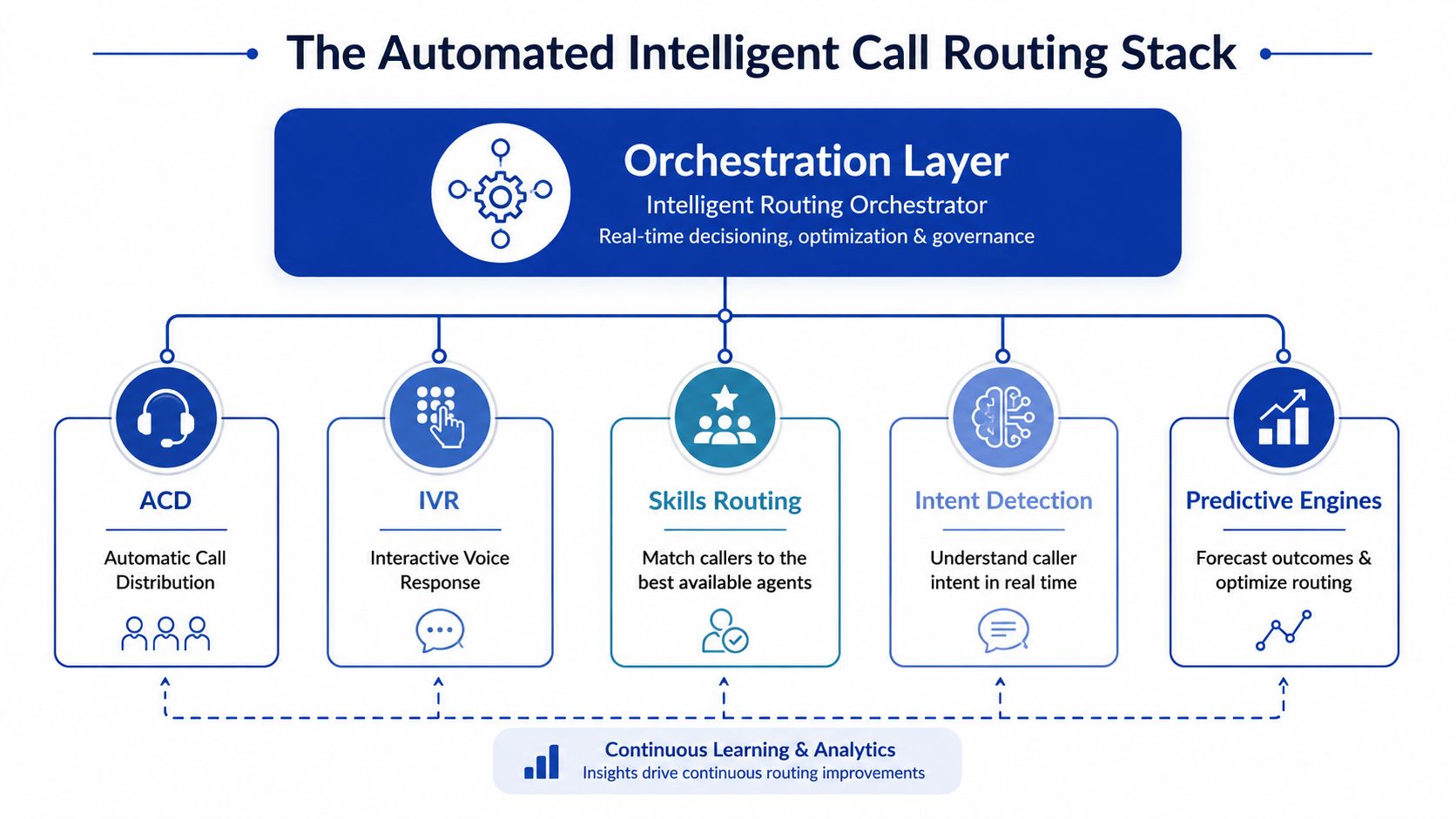
Automated intelligent call routing is the orchestration layer above the contact center's individual routing components. It connects ACD, IVR, skills-based routing, intent detection, and predictive decisioning so each layer contributes to one destination choice.
The distinction matters because these technologies don't carry equal responsibility.
ACD is the distribution backbone. It manages queues, agent availability, priority rules, and the basic movement of calls. ACD can apply skill tags, but by itself it generally follows configured rules rather than interpreting the full context of an interaction.
IVR is the intake layer. A modern IVR can collect account identifiers, authenticate a caller, capture the reason for contact, and offer approved self-service options before a live agent answers. In a regulated operation, that early exchange can also determine whether the call should enter a payment-safe, privacy-restricted, or dispute-specific workflow.
Skills routing converts job descriptions into usable capability data. A profile might include Spanish fluency, FDCPA training, hardship negotiation authority, healthcare billing knowledge, PCI-DSS payment scope, or insurance claims expertise. The engine then matches those attributes against the caller's needs instead of treating every available agent as interchangeable.
Intent detection classifies the conversation. Speech recognition and natural language processing can identify whether the caller is asking about a balance, challenging a debt, disputing a credit-related record, requesting financial assistance, or seeking a claim update. The classification should also carry a confidence level, because low-confidence decisions need a safe human fallback.
Predictive routing adds outcome history. Rather than selecting only the next idle agent, the system can evaluate which available agent-caller pairing is most likely to produce a resolved interaction, an appropriate payment arrangement, or a successful escalation.
A phone tree asks the caller to select a menu option. A chatbot handles a conversation, usually through a digital channel. A CRM screen-pop displays information after a destination has already been chosen. Skills routing matches predefined attributes, but it may not account for changing intent, queue pressure, consent, or caller history.
Intelligent routing is the coordination of those capabilities. IVR outputs can populate a skill vector. Intent classification can change the queue choice. Predictive scoring can override simple longest-idle logic when the operation has a stronger compliant destination.
Automation only creates value here when it completes a decision path. Adding another interface without a decision behind it doesn't move the caller any closer to the right destination.
A routing engine shouldn't ask only, “Which agent is free?” It should ask, “Which destination creates the strongest compliant outcome for this caller, this queue, and this moment?”
That is a state-aware optimization problem. Skills-based routing treats each interaction as a task with a required skill set and matches it to the agent or queue that best fulfills it without ignoring system state. In a regulated environment, that engine should also expose its routing trace, showing which inputs and rules produced each assignment, so supervisors can audit the decision after the fact.
Caller state includes identity status, stated intent, consent, time zone, contact history, account age, prior disputes, and channel history. A caller with an identified payment intent should not necessarily follow the same path as a caller whose identity remains unverified.
Agent state covers available skills, active workload, idle time, licensure, language, settlement authority, payment scope, and current call complexity. An agent can be available but still be the wrong destination.
Queue state includes SLA pressure, abandonment conditions, priority rules, regulatory cutoff windows, and the availability of specialist coverage. The engine must balance the needs of the current caller against the effect of the assignment on the wider queue.
| State Category | Sample Inputs | Routing Impact |
|---|---|---|
| Caller state | Identity, intent, consent, history, time zone | Determines eligibility, priority, and required workflow |
| Agent state | Skills, language, licensure, authority, workload | Filters and ranks qualified destinations |
| Queue state | SLA pressure, abandonment risk, cutoff window, priority | Adjusts assignment against real-time operating conditions |
| Interaction state | Verification stage, payment need, dispute reason, escalation status | Controls the next compliant action |
Predictive models can add a learned layer by evaluating call recency, channel, prior outcomes, and the fit between the caller's needs and an agent's demonstrated capabilities. That scoring should never operate as an unreviewable black box in a regulated environment. The operation needs a trace showing which inputs mattered and which rule or model produced the assignment.
A strong engine balances several objectives:
A single metric such as average handle time can push the engine toward the wrong answer. The best destination is the one that fits the entire operating state, not the agent who happens to have waited longest.
For organizations evaluating implementation options, Smart Call Routing provides a reference point for how skills, availability, priority, and customer history can inform destination selection.
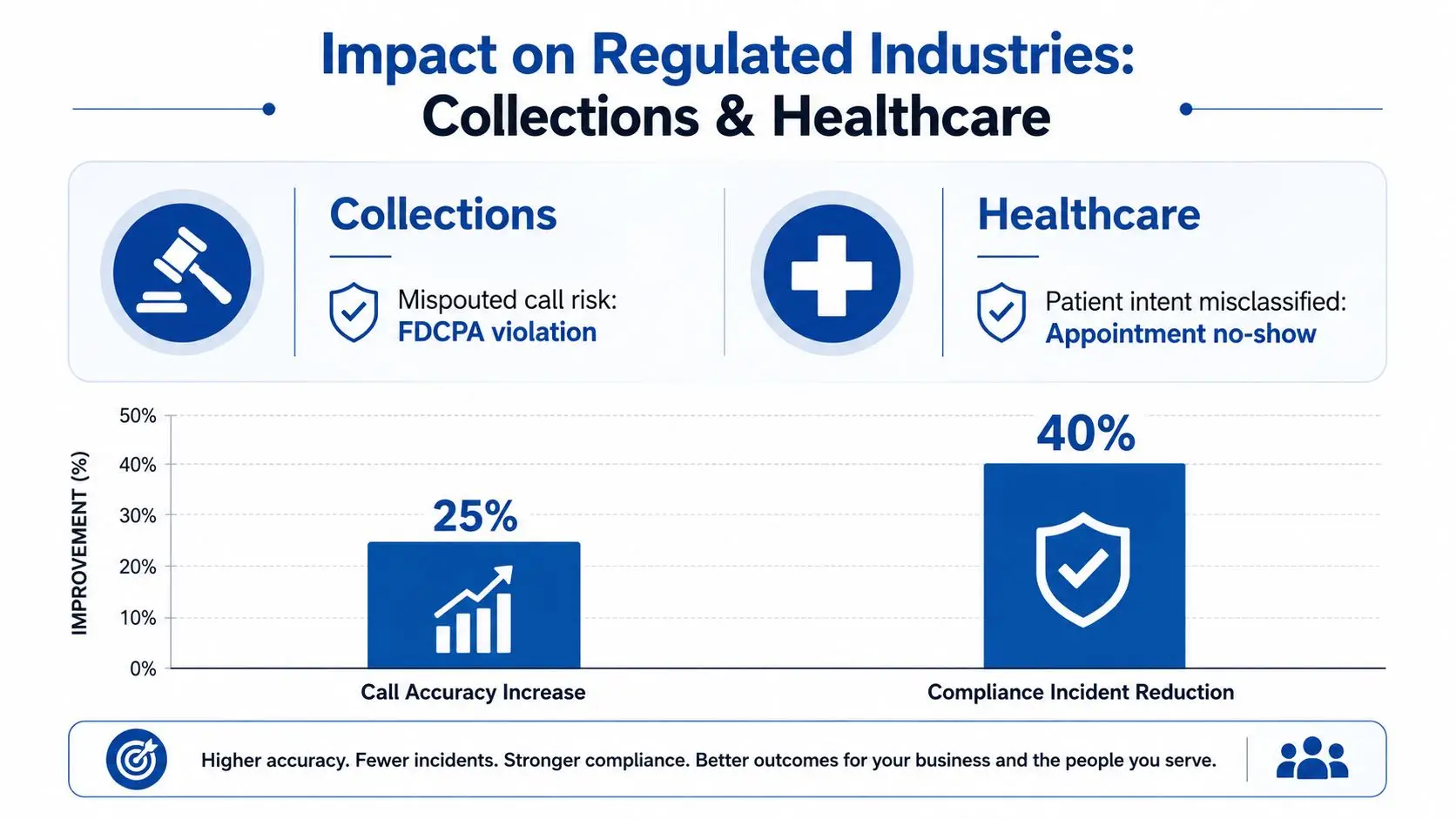
Collections and healthcare revenue cycle expose routing failures quickly because every interaction combines financial consequence, personal information, and a narrow margin for procedural error.
In third-party collections, the destination may depend on right-party contact confidence, account status, language, hardship expertise, and settlement authority. A caller who has already identified an account and wants to discuss a payment arrangement shouldn't be placed with an agent who lacks the authority to offer the appropriate option. A caller raising a dispute needs a different workflow from a caller asking for a balance.
The risk is also legal. A misrouted conversation can create problems under the Fair Debt Collection Practices Act, especially when identity verification, disclosures, or contact handling aren't controlled. The routing engine should treat those requirements as prerequisites, not after-the-fact quality checks.
Healthcare callers often arrive with financial anxiety and limited patience for internal boundaries. An uninsured emergency department self-pay inquiry may need a charity-care specialist. A Medicare appeals caller may need an appeals-trained representative rather than a general billing agent. A patient asking about a statement should not be transferred repeatedly while protected information is exposed across unnecessary desks.
Healthcare routing therefore needs to separate patient access, billing, prior authorization, financial assistance, and clinical escalation. It also needs to respect HIPAA, including limits on who may receive or discuss protected health information.
Natterbox's 2026 Contact Center Benchmarks report, drawn from 58.2 million calls handled in 2024 and 2025, found that average hunting time fell from 5.15 minutes to 2.37 minutes year over year, a 54% reduction, as organizations replaced static IVR menus with CRM-native and conversational AI routing. Connection rate rose from 52.5% to 60.6% over the same period. In financial services specifically, the report put 2025 routing time at 35.0 seconds against a 142.0-second cross-vertical baseline; the same report's Q1 2026 update puts the financial-services figure at 32.3 seconds.
Those figures don't justify automation by themselves. They show why regulated operators should measure pre-queue delay, connection quality, compliant resolution, and repeat contact together.
A faster wrong connection is still a wrong connection. The business case comes from reaching the right specialist with the right permissions and context.
Healthcare contact-center leaders can use healthcare contact center guidance to connect routing design with patient access, privacy controls, and revenue-cycle workflows.
Compliance doesn't sit beside routing. It changes the route itself.
TCPA affects consent, time zones, contact windows, and opt-out handling. An outbound engine should check those conditions before placing the call. If the window is closed or consent is unavailable, the system should suppress the attempt or send it to an approved follow-up workflow. A live agent shouldn't discover the restriction after the phone rings.
PCI-DSS affects payment handling and recording behavior. A caller ready to make a card payment should move into a payment-safe branch, such as an approved IVR or DTMF-controlled process that prevents sensitive card data from entering the agent recording or screen workflow.
HIPAA affects who can hear or access protected health information. A healthcare routing profile should carry consent and authorization status, then restrict the interaction to appropriately cleared staff and systems.
FDCPA affects debt-collection disclosures, identity verification, and permitted contact handling. A verified caller discussing an account can follow a different route from an unverified person seeking information about someone else's debt.
FCRA affects disputes and credit-reporting-related disclosures. Those contacts should receive a reason code and move to a specialized workflow rather than a general payment queue.
| Framework | Routing Impact | Required Pre-Routing Check | Skill or Queue Effect |
|---|---|---|---|
| TCPA | Controls outbound eligibility and contact timing | Consent, opt-out status, time zone, contact window | Suppression, compliant callback, or approved outbound queue |
| PCI-DSS | Restricts card-data exposure in calls and recordings | Payment intent and secure payment path availability | Payment-safe IVR or appropriately scoped payment team |
| HIPAA | Limits access to protected health information | Identity, authorization, and consent status | Cleared healthcare queue with restricted context |
| FDCPA | Governs debt communications and verification | Right-party status, disclosure path, account handling rules | Qualified collections or dispute queue |
| FCRA | Shapes dispute and credit-reporting workflows | Dispute reason and required disclosure path | Specialized dispute or compliance queue |
A compliant decision can be expressed as a sequence of gates: the TCPA window is open, PCI scope is minimized, HIPAA authorization is verified, FDCPA identity is confirmed, and the FCRA reason code is set. Only then should the engine match skills and queue conditions.
Regulated teams can use guidance on manual and automated dialing under TCPA when documenting outbound controls. The important operational principle is simple: a routing rule is a control, and every control needs an owner, an audit trail, and a defined failure path.
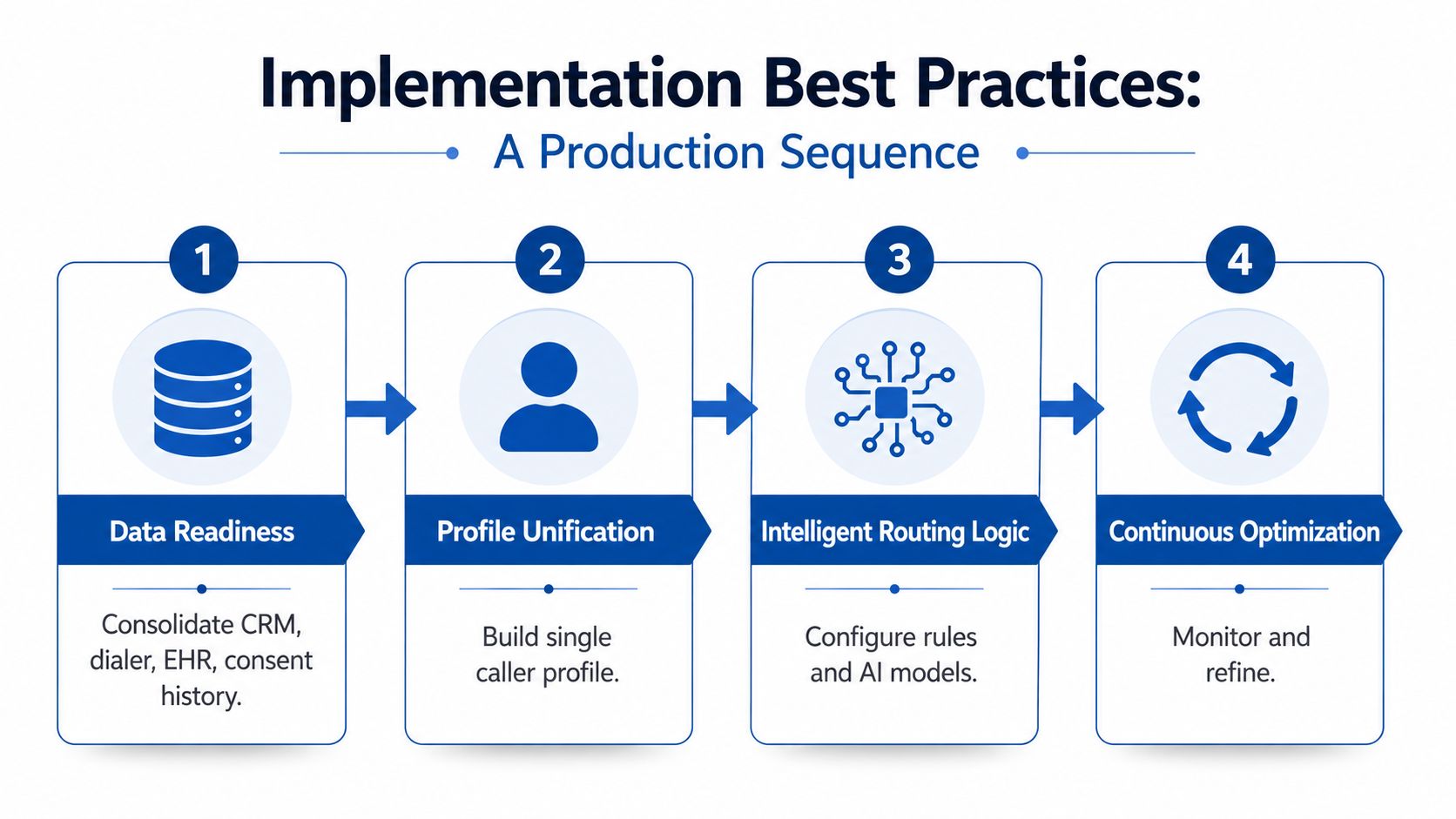
A production rollout should proceed as a controlled sequence, not a switch flip. The engine can't make reliable decisions if the caller profile is fragmented across a CRM, dialer, EHR, debt ledger, consent system, and payment application.
Consolidate the records needed for a routing decision into a caller profile the engine can access quickly. That profile should include identity, consent history, contact restrictions, prior interactions, account or patient status, open disputes, payment intent, and relevant specialist requirements.
Data readiness also means defining ownership. Compliance teams should own consent and suppression logic. Operations should own queue priorities. Training leaders should own skill certification. Without those boundaries, staff will debate routing outcomes instead of improving them.
Job titles are too broad. A useful skill vector might distinguish Spanish fluency from Spanish fluency plus FDCPA certification, or healthcare billing knowledge from authority to discuss a specific category of protected information.
Keep the profile interpretable. If an agent has too many overlapping tags, the engine can't distinguish meaningful expertise from generic availability. Each skill should have a source, an expiration rule where applicable, and a supervisor who can approve changes.
Vendor-default intent categories rarely reflect the way a collections agency, hospital, insurer, utility, or government office receives calls. Use anonymized transcripts and real disposition codes to identify the language callers use for disputes, hardship, payment plans, appeals, and complaints.
Review misroutes on a fixed cadence during the early operating period. The review should ask whether the model misunderstood intent, the profile lacked a required attribute, the compliance gate was incomplete, or the destination queue was configured incorrectly.
Shadow mode lets new routing logic run beside the live process without controlling the destination. The team can compare the recommended route with the actual route, identify low-confidence intents, and test compliance exceptions before callers experience the change.
Go-live should include a guardrail queue for uncertain classifications. That queue gives a trained human triage agent responsibility for ambiguous calls instead of forcing the model to guess.
Common failures include:
Implementation budgeting should account for integrations, governance, testing, training, and post-launch review rather than only license costs.
The most common mistake is treating a routing problem as a capacity problem. Leaders add agents, add channels, or buy another point solution while the existing decision logic continues sending callers to the wrong destination.
More agents don't fix weak matching. If skill definitions are vague, additional staff spread expertise across more queues. A collections operation can have enough people online and still miss payment intent because the system can't distinguish settlement authority from general account servicing.
More channels can increase fragmentation. Adding SMS, email, chat, and self-service without a shared caller-state model creates new handoffs back to voice. The agent may receive a transcript without identity status, consent history, payment context, or dispute classification. That isn't omnichannel service, it's the same routing failure wearing more channels.
Another AI layer can create conflicting records. A standalone intent engine may classify the caller one way while the ACD, CRM, or compliance system holds a different account state. In a regulated environment, two competing sources of truth create audit and privacy risk.
Before buying capacity, operations leaders should answer five questions:
Platform consolidation can change the routing math because one caller-state model governs more of the interaction. Embedded payments can reduce unnecessary handoffs and keep payment data inside a controlled workflow. A single decision engine can also apply consistent rules across voice, messaging, self-service, and agent-assisted interactions.
Intelligent Contacts combines a unified contact center and payments workflow with intelligent routing, IVR, communications, and secure payment processing. Its in-house architecture includes Grace, an AI collection agent, and integration paths for CRM, EHR, billing, and other operational systems.
The real question isn't whether a team needs more automation, it's whether that automation is buying more activity or better decisions.
Intelligent Contacts can help regulated collections, healthcare revenue-cycle, financial-services, insurance, government, and utility teams connect caller state, compliant routing, agent skills, and payment workflows in one system. Visit Intelligent Contacts to schedule a demo or see how the platform can support a measurable routing and recovery review. For direct contact, use the company's website contact options to connect with the Intelligent Contacts team.