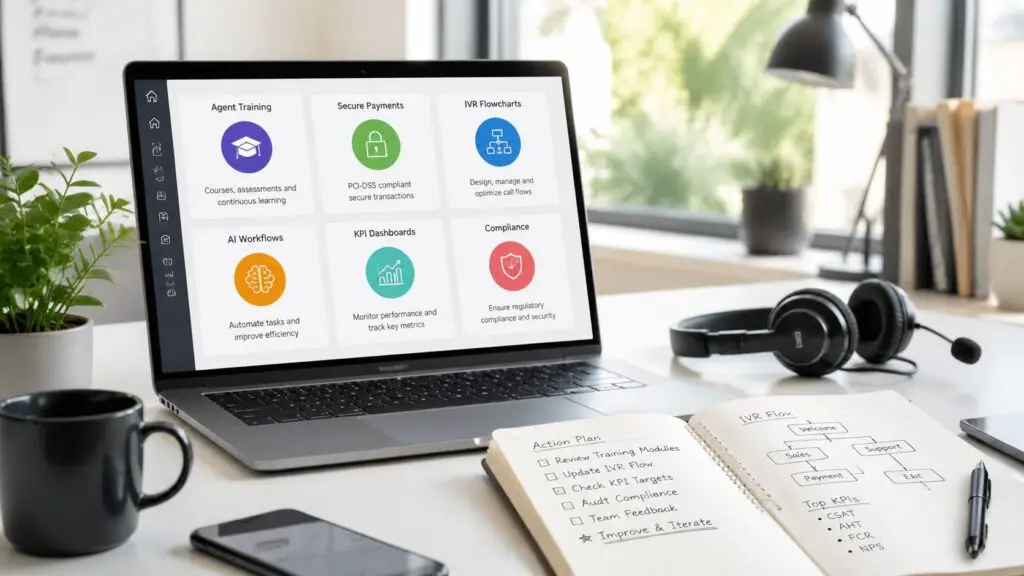
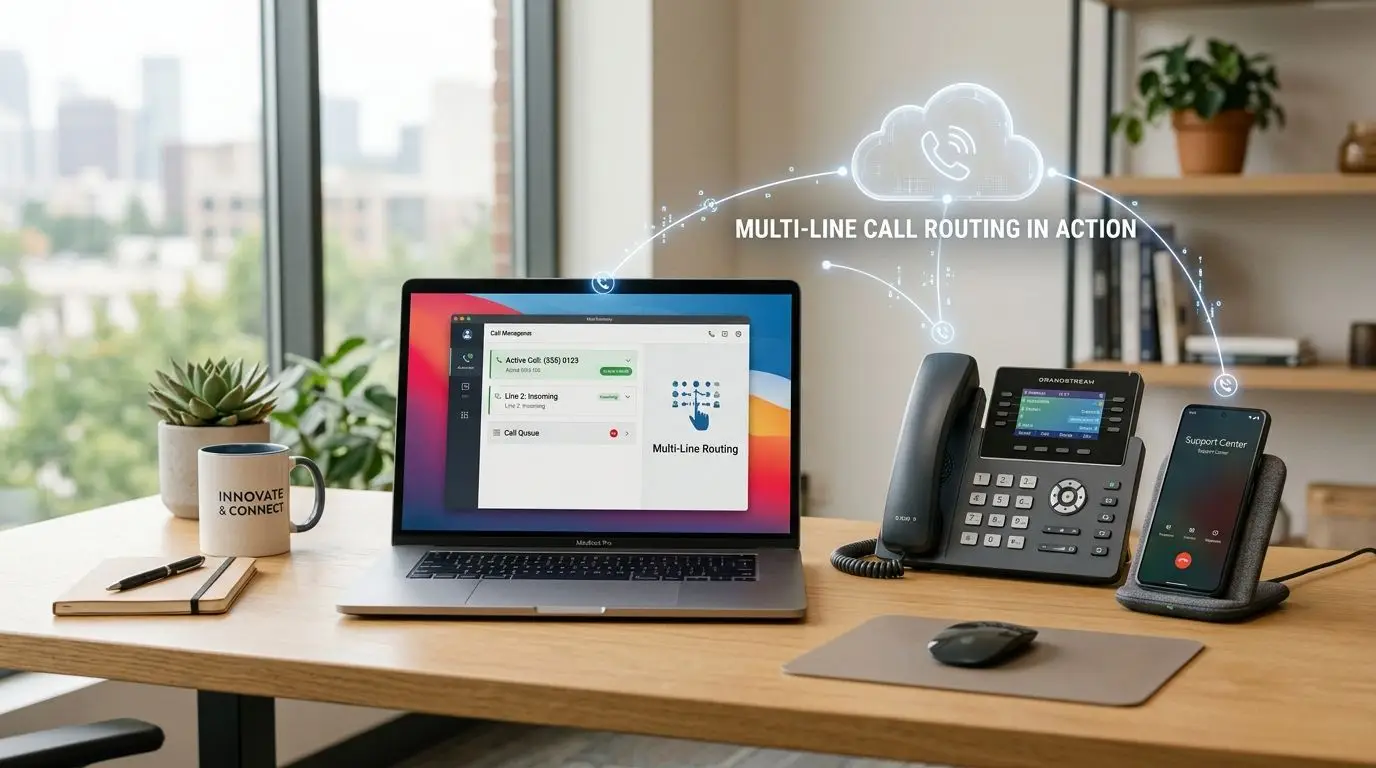
A lot of small businesses still treat phone service like office plumbing. It isn't. In regulated operations, the phone system controls intake, authentication, dispute handling, payment capture, documentation, and escalation. That makes it an operational platform choice, not a handset choice.
That distinction matters most in collections, healthcare revenue cycle, financial services, insurance, utilities, and government service environments. A missed call isn't just a missed conversation. It can be a missed payment, a delayed resolution, a complaint, or a compliance event that someone has to clean up later.
A single line setup fails in exactly the way busy teams can't afford. One employee is on the phone, another caller hits a busy signal, and the business never gets a second chance. In regulated environments, that missed call may have been a patient trying to settle a balance, a borrower responding to outreach, or a customer calling before a dispute escalates.
The problem isn't theoretical. Sunco reports that the average small business misses up to 62% of inbound calls and notes that cloud-based multi-line services typically cost $15 to $45.95 per month for a number that supports multiple calls, with some plans starting at $15 per seat in its overview of multi-line systems. That should end the debate for any operations leader still relying on a basic single-line setup.
Practical rule: If revenue, payments, service recovery, or regulated conversations arrive by phone, a single line is already too small.
What works is simple. Multiple people need to answer at the same time. Calls need to route correctly. Overflow needs to land somewhere useful instead of disappearing into voicemail chaos. The business case isn't complicated. Paying a modest monthly amount to stop avoidable call loss is usually the easiest operational decision on the table.
A busy Monday morning exposes bad architecture fast. The front desk is fielding patient balance questions, a collector needs recorded proof of consent, and a supervisor is trying to trace a disputed payment. If the phone system cannot route, record, secure, and document those interactions without extra workarounds, it is the wrong system.
The decision is not desk phones versus headsets. It is whether your business wants to manage telecom infrastructure, rent a cloud phone service, or preserve part of an aging setup. In healthcare, finance, and ARM, that choice affects audit readiness, payment handling, business continuity, and how much operational friction your team absorbs every day.
An on-premise PBX keeps call control inside your facility. Some leaders like that because it feels familiar and gives them direct control over hardware.
It also gives them direct responsibility for upgrades, failover, carrier coordination, maintenance windows, and site-level outages. That burden rarely helps a regulated small business. Most operations leaders need reliable call handling and documented controls, not another system that depends on internal telecom expertise.
On-premise can still fit an organization with strict local infrastructure requirements and a capable IT team that already manages voice securely. For everyone else, it tends to consume time and budget that should go toward workflow control, QA, and payment recovery.
Hosted VoIP shifts the phone system into software managed off site. If you want a plain-language primer before evaluating providers, this overview of what is VoIP and how it works is a useful starting point.
For regulated teams, cloud architecture usually makes more operational sense than legacy phone gear. It is easier to standardize routing rules, user permissions, recordings, reporting, remote access, and business continuity policies when the core system is software-based. It also gives you a cleaner path to integrated workflows, including payment handling and queue-specific controls, instead of forcing staff to jump between disconnected tools.
That is also why many teams outgrow basic business phone service and move toward a contact center platform built on CCaaS architecture. The phone line matters. The operating model matters more.
SIP trunking replaces traditional phone lines with internet-based connectivity while keeping parts of an existing phone environment in place. It can be a reasonable transition option if your company has already invested in equipment it cannot retire yet or if you have location-specific technical constraints.
For a small regulated operation, SIP trunking is often a compromise, not an end state. You keep some old complexity, add new dependencies, and split responsibility across more moving parts. That usually makes compliance documentation, troubleshooting, and change management harder than they need to be.
| Attribute | On-Premise PBX | Hosted VoIP / Cloud | SIP Trunking |
|---|---|---|---|
| Ownership model | Hardware owned and managed on site | Service managed in software | Hybrid of existing equipment and internet trunks |
| Upfront burden | Higher setup and equipment burden | Lower infrastructure burden | Moderate, depends on legacy environment |
| Scalability | Slower, often tied to physical capacity | Faster, software-based expansion | Better than legacy lines, but still constrained by existing setup |
| Maintenance | Internal IT or outside support required | Provider-managed core environment | Shared responsibility |
| Remote work fit | Usually weaker | Usually strongest | Depends on current architecture |
| Disaster recovery posture | Local site dependence | Better suited to distributed operations | Mixed |
| Best fit | Organizations with strong in-house telecom needs | Most growing regulated businesses | Firms preserving older investments |
Choose the architecture that supports compliance controls, secure recordings, reporting, and payment workflows with the least operational drag. For most small regulated businesses, that means cloud first, hybrid only when legacy constraints force it, and on-premise only when you have a clear technical reason to own the burden.
Features only matter if they solve a business risk. In regulated environments, the right feature set reduces exposure, removes friction, and gives supervisors evidence when something goes wrong.
This is what teams should look for near the front of the evaluation process.
Call routing decides whether callers reach the right queue, the wrong employee, or nobody at all. That sounds basic, but bad routing drives repeat calls, abandoned conversations, and inconsistent handling.
IVR matters for more than menu prompts. In healthcare billing, collections, and financial services, IVR can support secure self-service flows, payment intent capture, and after-hours handling. It also creates consistency. Consistency is what regulated operators need.
A strong setup also includes disciplined message design. Teams revisiting greetings and routing logic can borrow practical ideas from this guide to setting up voice messages, especially when they need clearer prompts and less caller confusion.
Call recording isn't about surveillance. It's about proof. If a consumer disputes what happened on a call, if a patient says an agent gave conflicting information, or if a supervisor needs to coach against a policy standard, the business needs a reliable record.
Audit trails matter just as much. Leaders should expect clear logs showing who handled the call, what happened, and what actions followed. Without that, the organization is relying on memory during disputes. That's weak operations.
Operational advice: If the system can't produce a usable record of the interaction, it can't support a regulated workflow.
Mobile and browser access keep the operation running when staff are remote, distributed, or moved quickly during a disruption. That flexibility matters, but only if business identity, call controls, and policy enforcement stay intact.
Workflow integration is where many “phone systems” fail. Voice alone doesn't close the loop. Regulated teams need the call connected to account context, notes, dispositioning, and often payment options. A system that isolates communications from the rest of the workflow creates manual work and compliance gaps.
Cloud-first contact operations usually move in this direction over time, which is why many teams end up evaluating broader cloud contact center models such as those described in reasons to be in the cloud.
A regulated team usually discovers sizing mistakes the hard way. Monday morning call queues spike. Payment calls stack up. Staff start placing callers on hold while they switch between systems, and supervisors are forced to choose between speed, documentation, and policy control.
That is not a phone problem. It is a capacity and workflow design problem.
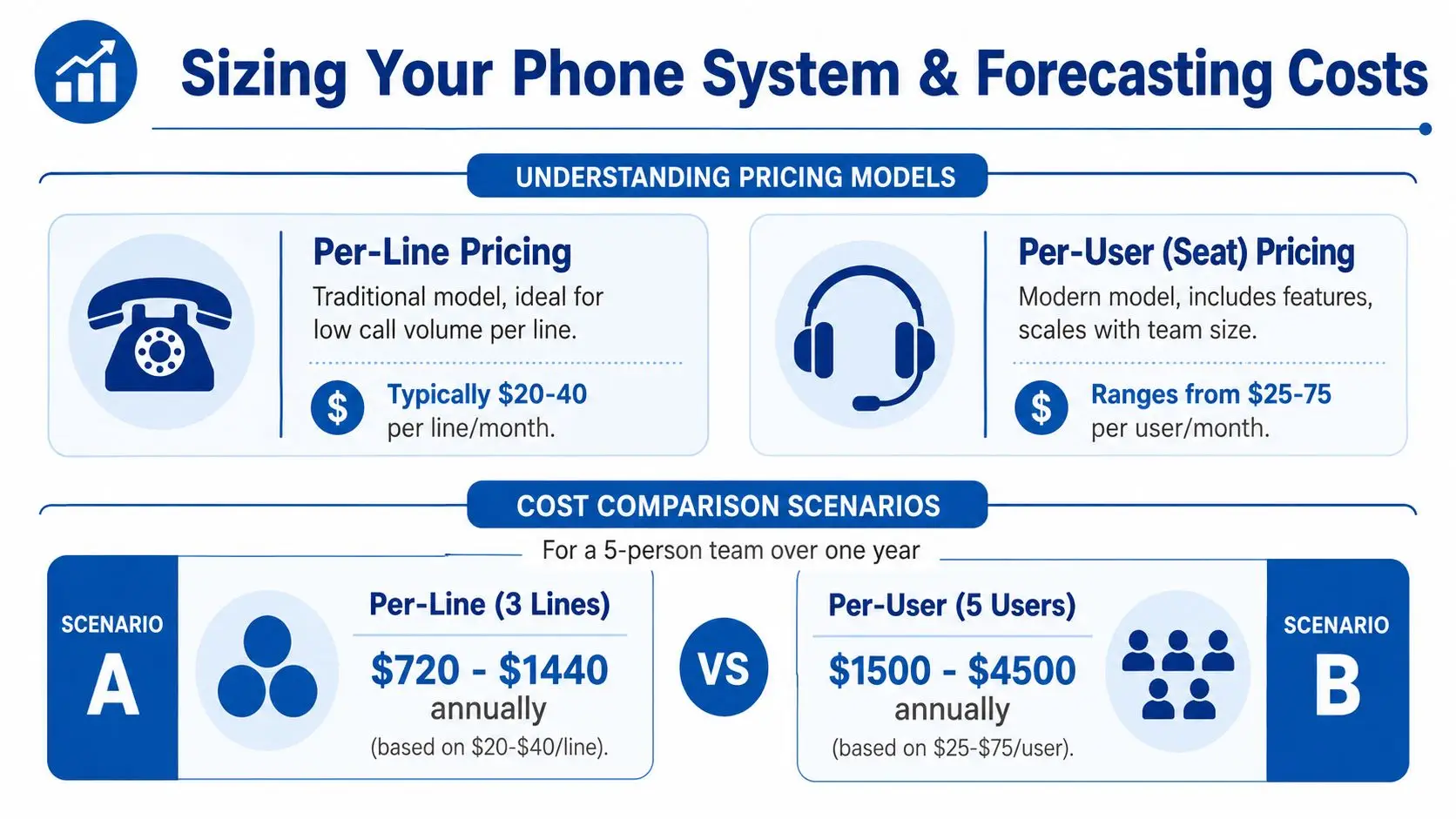
Headcount is a weak sizing method. Concurrent call demand is what matters.
A five-person medical billing office may need fewer active paths than a three-agent collections team handling inbound payments, outbound follow-up, and supervisor escalations at the same time. If your busiest 30 minutes create overlap, your system has to absorb that overlap without long holds, abandoned calls, or rushed interactions.
Use these questions to size the system correctly:
If your operation handles protected data or card payments, add buffer. Regulated calls often take longer because identity checks, disclosures, notes, and payment steps all consume time. Planning too tightly creates the exact failure you are trying to avoid.
The monthly subscription is the easy number. It is rarely the number that drives the actual decision.
Leaders should price the full operating model:
Workflow friction is where small businesses misread cost. A cheaper phone service becomes more expensive when agents spend extra minutes per call verifying information in one system, documenting in another, and taking payment somewhere else. In regulated industries, those minutes add labor cost and create more room for mistakes.
Integrated workflows usually justify a higher platform price. That is the business case. If communications, account context, and payment steps live in one controlled process, the operation reduces handle time, cuts rework, and lowers compliance exposure. Intelligent Contacts is one example of a platform built around that model for regulated contact center operations.
Do the math using peak-hour demand, average handle time, transfer volume, and the labor cost of every manual step. That approach produces a buying decision you can defend.
Most vendor reviews are too shallow. They focus on call quality, feature lists, and monthly pricing. That's not enough for healthcare, ARM, financial services, insurance, utilities, or government operations.
The key question is whether the vendor can support compliant execution every day, under pressure, with documentation.
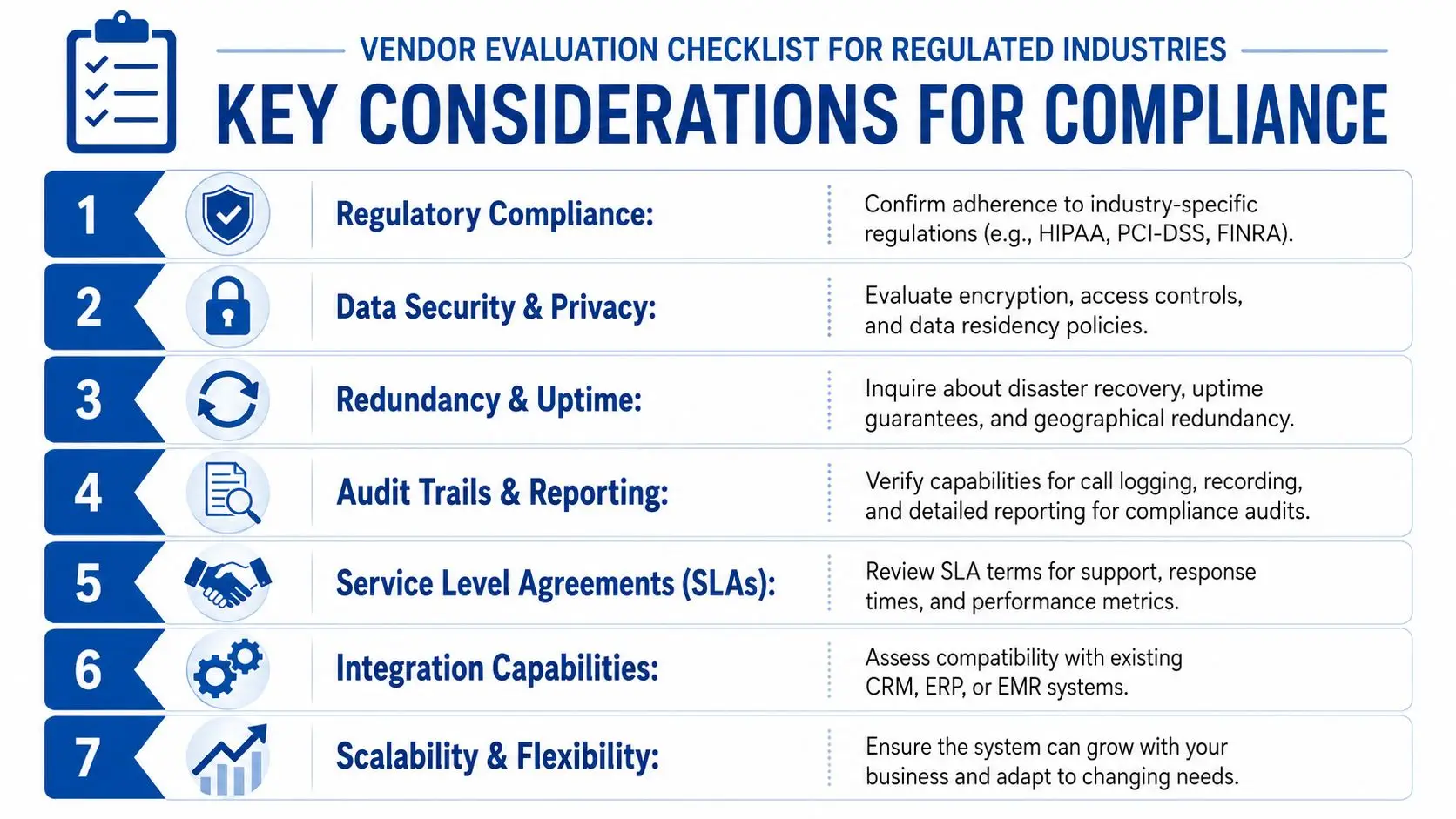
Regulatory alignment: The platform should be reviewed against the rules that govern the business. That includes TCPA for calling practices, HIPAA for protected health information, PCI-DSS for payment handling, FDCPA for collections conduct, and FCRA where credit reporting workflows intersect.
Security controls: Encryption, access controls, user permissions, authentication, and data handling policies need real scrutiny. A sales demo won't answer this. Security documentation will.
Auditability: The system should preserve call records, routing history, user actions, and reporting needed for internal review and external response.
Business continuity: Outages happen. The issue is whether calls reroute cleanly, staff can work remotely, and supervisors maintain visibility during a disruption.
Integration capability: The phone layer has to connect with the systems that hold account data, patient balances, payment status, and work queues. If not, agents will improvise. Improvisation causes mistakes.
A serious evaluation should ask direct questions:
That last question matters. Reseller stacks can work, but they often create support fragmentation. When routing breaks, recording fails, or an integration misfires, nobody wants three vendors arguing about ownership.
“The safest phone system isn't the one with the longest feature list. It's the one that keeps the operation inside policy when agents are busy and supervisors are stretched.”
Connectivity planning also deserves attention, especially for distributed teams and regional offices. For organizations reviewing telecom resilience in international or outsourced environments, this piece on addressing connectivity problems for Philippine companies is a useful operational reference.
Some red flags should end the conversation immediately.
Implementation fails when teams treat deployment like an IT event instead of an operational cutover. The technology can be sound and the rollout can still collapse because call flows, training, and number management were rushed.
A smooth deployment follows a sequence. Not a scramble.
The first job is mapping how calls should move through the business. That includes inbound routing, overflow logic, after-hours handling, voicemail destinations, and escalation paths. In regulated operations, it also includes approved language, authentication steps, and payment transfer rules.
Porting existing numbers also needs planning. Customers, patients, and account holders already know those numbers. Keeping them stable avoids confusion and protects continuity.
A good deployment team configures the system around actual work. That means tying queues to departments, linking agents to the right account context, and making sure notes and dispositions match business processes.
This is also where emergency planning belongs. Teams moving to internet-based phone service should review requirements such as E-911 support for VoIP environments so location and response expectations are handled correctly.
Basic training is never enough. Agents need to know what to do when the caller fails authentication, requests a payment arrangement, disputes a balance, asks for a supervisor, or calls after hours. Supervisors need to know how to review interactions, monitor routing, and fix queue issues without waiting on support.
A practical rollout usually includes:
A senior operations director noted, “We expected a multi-week headache. Instead, we were making and taking calls on the new system within three days. The process was defined and the support was there.”
That outcome doesn't happen by accident. It happens when the provider has a repeatable onboarding process and the buyer insists on operational discipline. For teams under compliance pressure, days matter. Every extra week on an outdated setup means more workarounds, more manual handling, and more avoidable exposure.
The first week after cutover should be controlled closely. Queue reports, missed call patterns, transfer behavior, and voicemail handling need daily review. Small routing issues become customer-facing problems fast if nobody owns post-launch tuning.
The best deployments aren't dramatic. Staff log in, calls route correctly, records are captured, and payment or resolution workflows continue without friction. That's the standard.
A small business in a regulated industry doesn't need “more phone features.” It needs controlled communications, reliable documentation, and a path from conversation to resolution without manual gaps.
That's why the right multi line phone systems for small business should be evaluated as operating infrastructure. The choice affects revenue capture, dispute handling, payment workflows, and compliance posture across TCPA, HIPAA, PCI-DSS, FDCPA, and FCRA-driven environments.
The strongest decision criteria are straightforward. Choose architecture that scales without hardware drag. Demand features that support routing, records, and secure self-service. Vet vendors on compliance, security, auditability, and workflow integration. Deploy with a cutover plan that protects continuity.
Treat the phone system like a strategic layer of the business, because that's what it is.
Intelligent Contacts brings voice, SMS, email, chat, and payments into one workflow for regulated contact center operations. Teams that need a multi-line business calling environment with integrated payment handling, compliance-focused controls, and implementation in days can Schedule a Demo or See Your ROI. For direct inquiries, contact Intelligent Contacts through the website's sales and support channels.